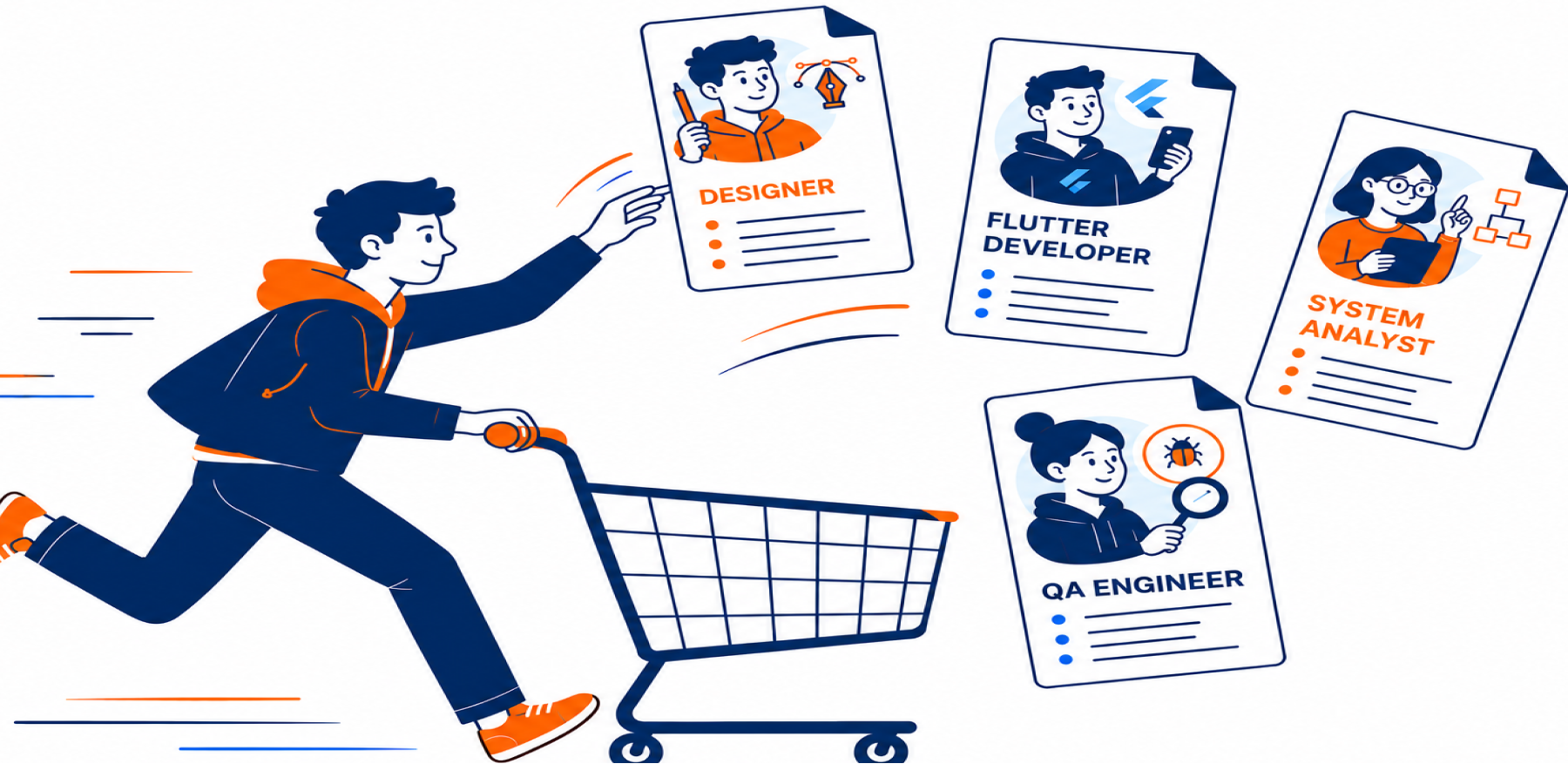
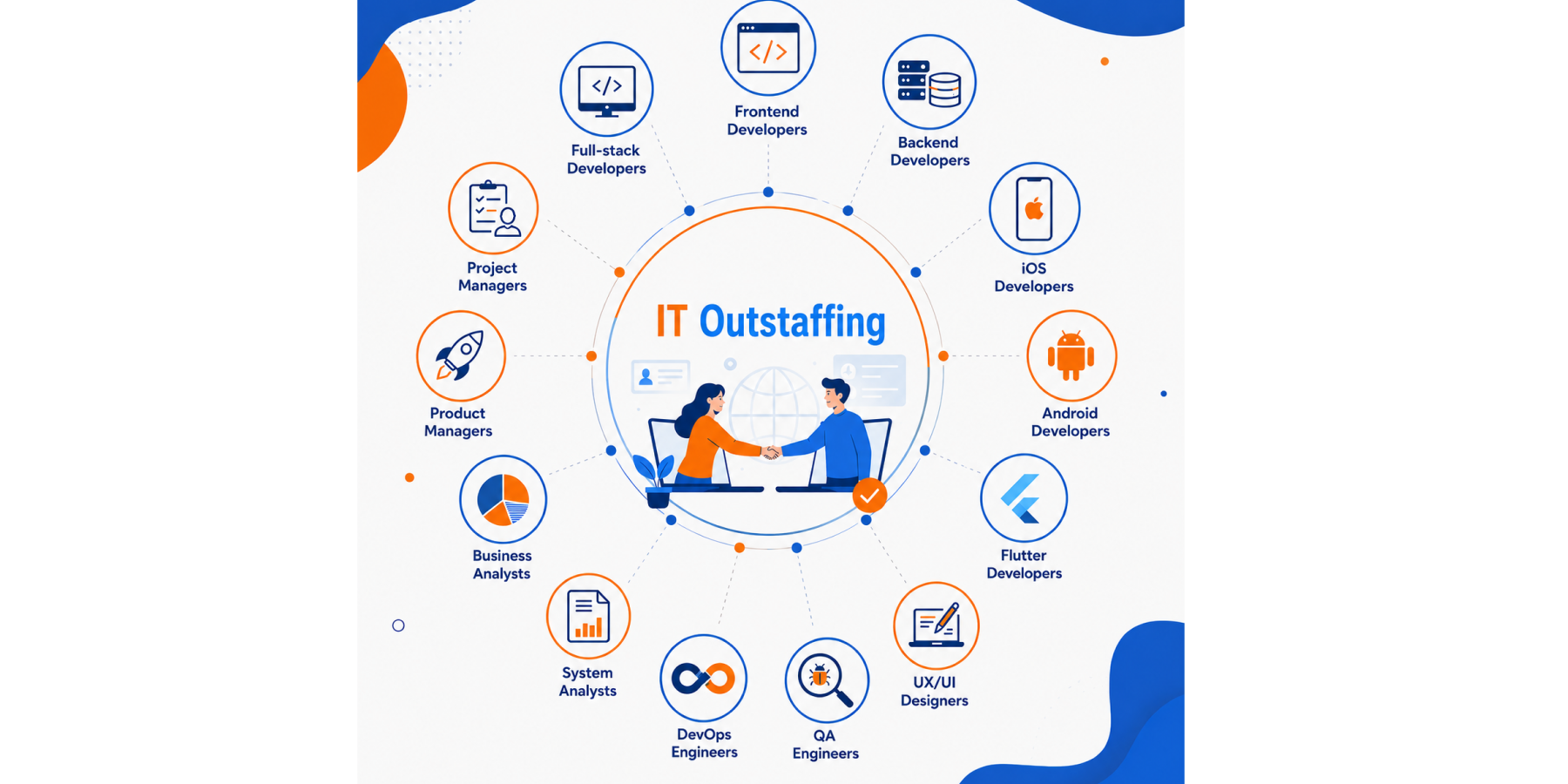
IT outstaffing is a work model in which a company leases specialists from a contractor, while maintaining full control over tasks and processes. It sounds simple, but many customers have a question: which specialists can be involved in the project and why are they needed?
In this article, we will look at which IT specialists are usually included in the project team and what each role does.
When a company turns to outstaffing an IT agency, it solves a specific task: to close the gap in expertise or accelerate development without a long hiring process.
But connecting «just a developer» is not enough. An incorrectly defined role leads to the fact that work is done slower, technical debts appear and it is more expensive to correct mistakes than to initially hire the right specialist.
For example, at LighTech, we help a customer formulate team requirements even at the onboarding stage — and select Middle+ and Senior-level specialists who integrate into work processes from day one.
Front-end developers are responsible for everything that the user sees and interacts with in the browser or application: interfaces, animations, adaptive layout. They work with JavaScript, TypeScript, React, Vue and other frameworks, are able to integrate the API and monitor the performance of the client side.
When a frontend specialist is needed:
The backend is the «engine» of any digital product. A backend developer builds server logic, designs databases, creates APIs, and ensures data transfer security. It runs on Python, Node.js, Java, Go, PHP and other languages, depending on the requirements of the project.
When a backend specialist is needed:
Native mobile developers create applications for specific platforms — iOS or Android. iOS developers work with Swift and Objective-C, use the capabilities of the Apple ecosystem and provide high-performance applications on the iPhone and iPad.
Android developers use Kotlin and Java, take into account the features of different devices and OS versions, and also work with the Android SDK and Google Play.
Native development allows you to achieve stable application performance, deep integration with device functions, and high-quality user experience.
When you need mobile developers for Android and iOS:
Flutter is a cross—platform framework from Google that allows you to create applications for iOS, Android, web and desktop from a single code base. This approach helps to launch digital products faster, maintain a single interface on different platforms, and optimize development costs.
When you need a Flutter developer:
The UX/UI designer designs the user experience: analyzes the target audience, builds user scenarios, creates wireframes and final layouts. A specialist understands business tasks and creates an interface that solves them, rather than just looking attractive.
When you need a UX/UI designer:
QA (Quality Assurance) — specialists who test the product before the user sees it. They find bugs, verify compliance with requirements, test edge cases, and evaluate performance under load. A QA engineer is insurance against costly mistakes in production.
QA specialists work with both manual testing and automation: Selenium, Cypress, Appium — depending on the project stack.
When a QA engineer is needed:
A DevOps engineer builds CI/CD pipelines, manages cloud infrastructure (AWS, GCP, Azure), sets up monitoring, and ensures reliable deployment. Without a strong specialist, even well-written code can cause downtime and losses.
When a DevOps engineer is needed:
A system analyst is the link between business and development. He translates business tasks into the language of technical requirements: describes the architecture of integrations, draws up technical specifications, studies use cases and helps the development team understand what needs to be implemented and how. It is especially indispensable on projects with multiple external systems or highly complex logic.
When you need a system analyst:
If a system analyst looks at the «how», a business analyst looks at the «why». He explores the market and competitors, analyzes data, identifies bottlenecks in the company's processes, and formulates product requirements from a business perspective. A business analyst helps to ensure that the solution being developed will actually bring value.
When you need a business analyst:
The product manager manages the product: he has a vision, sets priorities in the backlog, works with metrics and makes decisions about functionality. The specialist does not manage the team directly — he manages the product through the team.
When you need a Product Manager:
The project manager is responsible for ensuring that the work is completed on time, within budget, and in compliance with requirements. He sets tasks, holds meetings, tracks progress, and serves as a point of communication between the team and the customer. The project manager shuts down the operational chaos and allows developers to focus on the code.
When you need a Project Manager:

The answer depends on the stage of the project and the tasks.
|
Project stage |
Who to connect |
|
There is no product, just an idea |
Product manager, UX/UI designer |
|
There is a design, we need development |
Frontend, Backend, Mobile Developers, QA |
|
The product works, but is unstable |
DevOps, QA |
|
There is no clarity in the requirements |
System analyst, business analyst |
|
Everything is on fire, there is no coordination |
Project Manager |
When working with LighTech, the team is formed together with the customer at the start — we specify the goals, objectives and limitations, after which we offer the optimal set of specialists. No unnecessary roles or overblown teams.
When outsourcing, you outsource the project to an external company.: she forms a team, manages it and is responsible for the result. With outstaffing, specialists integrate into your team and work under your guidance — you retain control over tasks, priorities, and processes.
This is a fundamental difference: outstaffing is the targeted strengthening of your team by specific experts, rather than transferring responsibility to the side.
Yes. IT outstaffing does not involve a minimum number of specialists. You can hire one senior developer for a specific task or form a full-fledged team of 8-10 people, depending on the needs of the project.
Task management remains on the customer's side. You set tasks, set priorities, and control the outcome. LighTech takes care of administrative matters: employment, taxes, equipment and legal support.
We will promptly select a replacement. Before joining the project, each specialist undergoes a qualification check — you get several profiles to choose from and conduct your own interview. If something goes wrong in the course of work, we react quickly.
After approval of the profile, within a few business days. Onboarding includes setting up access, integration into work tools (Jira, Slack, GitHub, etc.) and synchronization with the customer's team.