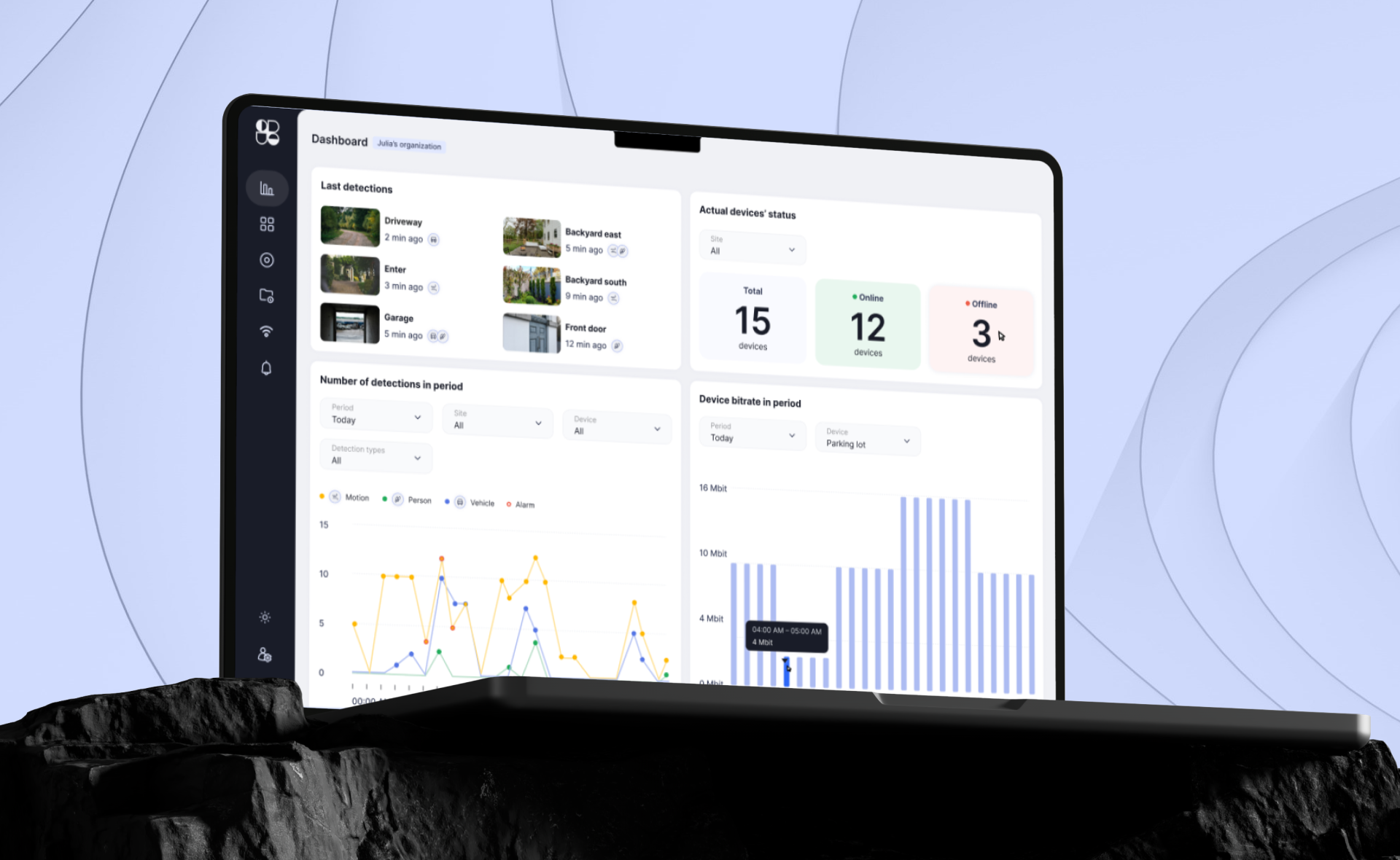
The project was developed for a technology company specializing in security systems for commercial facilities, government agencies and infrastructure.
The client was asked to create a scalable video surveillance system with remote access based on artificial intelligence technologies.
According to the customer's requirements, the intelligent video surveillance system was supposed to provide:
Reliable protection and real-time monitoring
Scalability and integration with other systems
Automatic video analysis and suspicious activity alerts
Convenient remote access via the web application and mobile version
Flexible management of cameras, users, and settings
It was important to the client that the solution was suitable for a wide range of users — from small businesses to large corporations and government agencies.
We have implemented a high-tech cloud-based video surveillance platform with video analytics from scratch, including a web interface and backend architecture.
To implement the project, we:
We have engaged analysts to study the needs of a potential audience (business, retail, shopping malls, government agencies, etc.).
We chose accent colors — red, symbolizing vigilance (analogous to the "REC" indicator). The main background is shades of blue, conveying trust and reliability.
Integrated cloud technologies with the ability to scale and securely store video archives.
We have developed a frontend in HTML, CSS and JavaScript, providing an adaptive interface.
We have set up a server side with an API and a database for reliable data exchange.
We have created a universal mechanism for remote camera search and connection, which does not require the user to be on the same network as the devices.
We have added the function of opening the camera's web interface from anywhere in the world - without the need to configure port forwarding or additional manipulations with the router.
We have ensured compatibility with any cameras that support RTSP (over TCP) so that the system is as versatile as possible and independent of the individual characteristics of the devices.
We have implemented support for the ONVIF protocol for controlling cameras and receiving action data, both locally and remotely. This has expanded the functionality of the platform compared to most of its analogues.
Special attention was paid to cross-platform compatibility. The cloud version is designed with minimal system requirements in mind, which allows it to run on almost any device — from network routers and IoT gadgets to data warehouses and even "smart" household appliances like kettles or refrigerators.:
the minimum version takes up only 9 KB of memory (the maximum is up to 900 KB);
It is suitable even for outdated cameras and microcontrollers.
For complex tasks, an extended version of the agent is available, which works in various modes — bridge, NVR, server, desktop.
In bridge mode, the device combines streams from multiple cameras, encrypts the data, and transmits it to the cloud. This can be useful for production facilities when you need to connect the entire infrastructure via a single device, save resources and get up to 1 Gbit/s performance when transmitting and processing information.
The cloud module easily adapts to different network configurations and greatly simplifies camera setup: all control takes place through a single interface, and routing and connection are automated.
Study
We conducted a threat analysis, studied competitive solutions and how video analytics works in other systems. We also tested compatibility with various hardware and identified custom scenarios.
Warframes
We created black and white warframes that allowed us to focus on the logic and structure of the interface without being distracted by visual details.
Visual design
We have developed a UI kit and a color scheme adapted to meet the security challenges and needs of end users. We have prepared the final layouts for transfer to development.
The frontend
Backend
Testing
We conducted functional, UX, and load testing of the software at all stages. We have ensured high stability and compliance with industry requirements.
The main features of smart video surveillance:
Mobile Access — system management and live video viewing from anywhere in the world through a convenient mobile version.
Video analytics with artificial intelligence — automatically detects movement, intrusions and other anomalies using intelligent algorithms, reduces the burden on operators and speeds up the response.
Cloud storage is a secure archive storage with the ability to partially delete, export, and segment records. You can independently control what is stored and for how long.
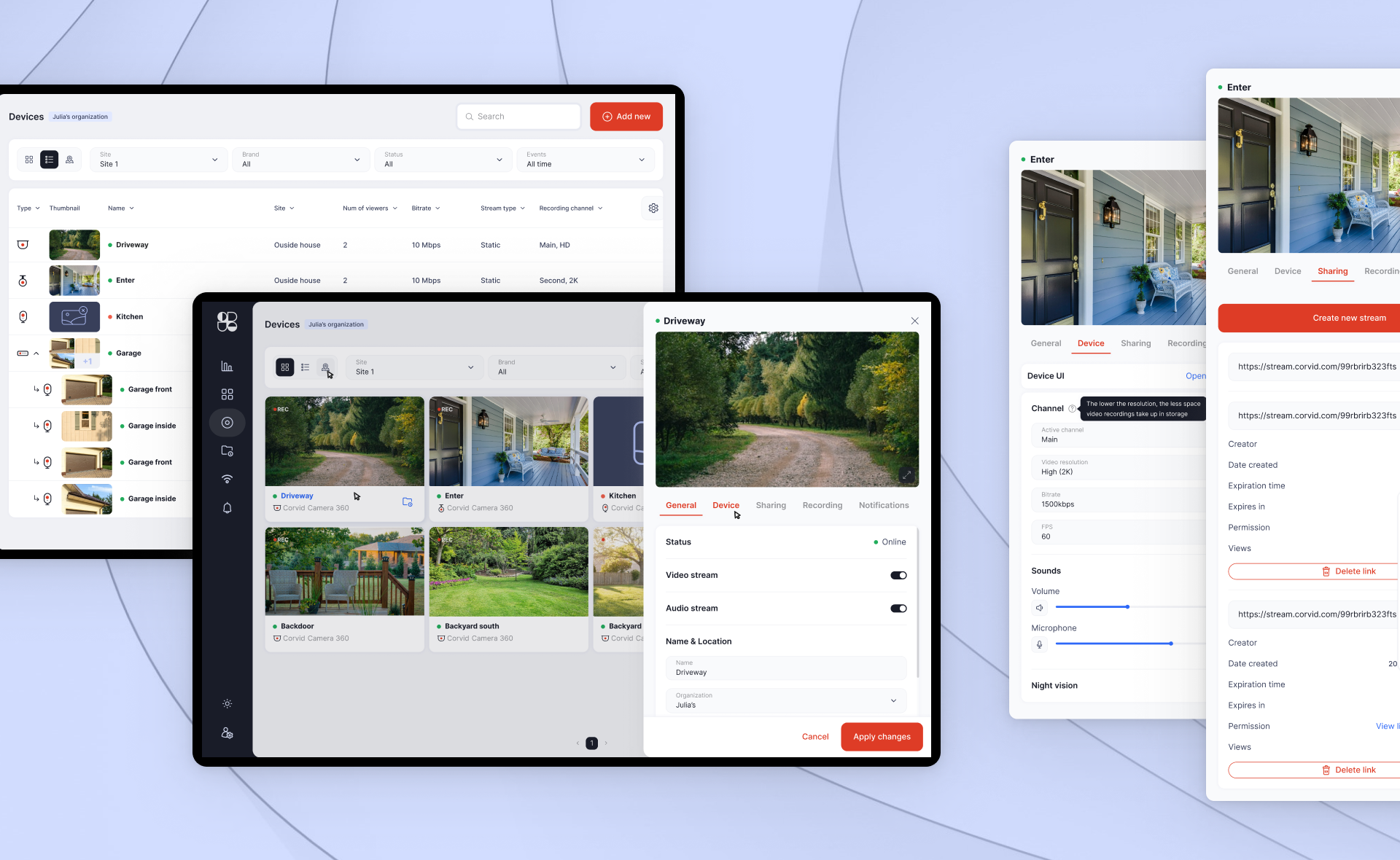
Flexible Settings — configure the organization's structure, roles, and access rights. It is possible to invite other users and set individual system configurations for specific tasks.
Device Management — centralized control of all cameras and other connected devices. Sharing is supported so that the right users can see only what they need.
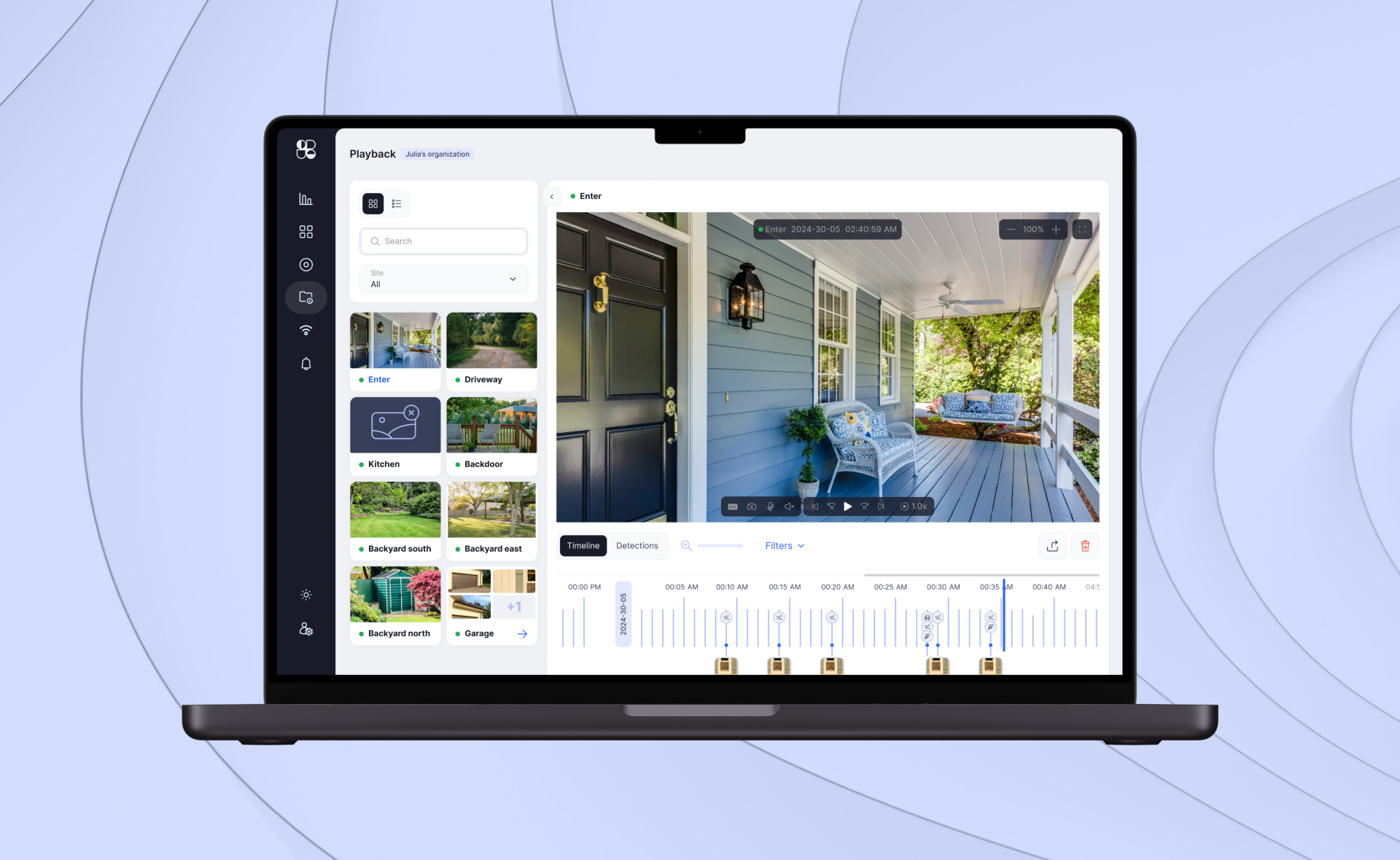
Monitoring grids — setting up convenient schemes for displaying video streams from multiple cameras. This helps you quickly navigate the situation and effectively allocate areas of responsibility.
The playback section provides full access to the video archive. You can search for the right moments on the timeline or view only clips created based on detector events.
Collaboration — the system makes it easy to share access, combine the efforts of several administrators, and effectively manage video surveillance in a team.
High performance — low-level stream processing without using heavy libraries (FFmpeg). The video is not transcoded, but mixed, which allows you to support tens of thousands of cameras on a single server.
The flexibility of video streams ensures stable operation even with an unstable network. Supports all modern protocols (RTSP, HLS, SRT, etc.), including synchronization with an SD card.
Codec support — compatibility with major video and audio codecs (H.264, H.265, AAC, PCM, etc.), as well as preparation for work with AV1, VP9, OPUS.
We were faced with the task of choosing an architecture capable of providing the optimal balance of flexibility, scalability and security. Collaboration with experts in the field of cloud video surveillance and constant feedback from the target audience allowed us to design a high-quality intelligent video surveillance system.
The platform is built using multiple server nodes and a load balancing system, which allows:
efficiently handle large amounts of traffic;
distribute requests evenly between servers;
ensure stable operation even under peak loads or failures of individual components.
The CORVID project has become an effective video analytics service that has been able to solve security problems in the commercial, government, and educational sectors.
Thanks to flexible settings, mobile access, and intelligent video surveillance with video analytics, the platform has been praised for its ease of use, security, and technological capabilities.