Previously, mobile apps were associated with games like Fruit Ninja, but today they have become a tool for solving everyday tasks. People use smartphones to order food, book tables, pay for utilities, study, monitor their health, and much more. Even pharmacies offer discounts for installing their app. For businesses, this is a way to retain customers and increase loyalty by turning a user's smartphone into a point of direct contact.
Planning the time frame for the development of a mobile application is the main factor in the success of the project and optimizing business costs. With a roadmap, you can effectively allocate investments and minimize risks.
In this article, we will tell you how to create a mobile application, highlight the development dates and stages.
To start the process of creating your product, the customer needs to provide basic information about the project. First of all, it is important to understand who will use the application and what task it solves. You also need:
1. Business model data, monetization methods, timing (for example, if you need a release for a meeting with investors), competitor analysis.
2. Portrait of the target user — age, income level, behavior, and other important features.
This information helps to accurately estimate deadlines and arrange work so that the application covers important business tasks.
The presence of a monopolist — if there is an application in a niche with revenue of $ 1 million per month, then there is demand.
Competition is ideal if there are several weak players besides the leader. This means that you can take second place.
A simple product idea is better to start with utilities (trackers, calculators), where complex content is not required.
Globality — a niche should be in demand in different countries, not just in local markets.
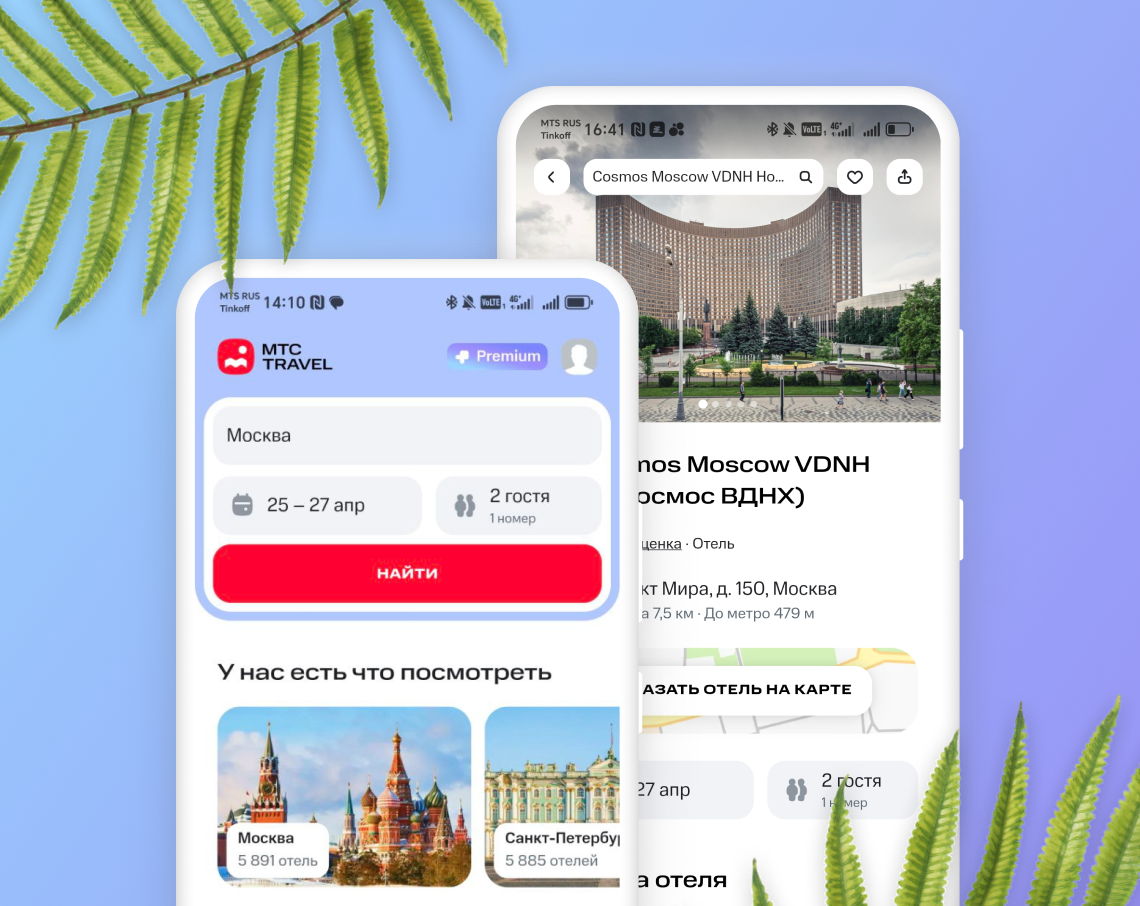
Even in a saturated niche, you can succeed if you understand the needs of the audience and the goals of the business. As an example, our MTS Travel project. The niche of travel services is competitive, but in demand. The client has set a goal to create a convenient booking tool linked to the MTS ecosystem. The team received all the information, which allowed us to launch the application in 3 months and launch a new direction — development on Flutter within the company.
The optimal structure of a mobile application development team consists of 5-6 people: a project manager, a designer, a couple of developers and a tester. Specialists can be hired on staff, found on a freelance basis, or connected through IT outstaffing. The latter option often turns out to be the most convenient and profitable: it is cheaper than maintaining a permanent team, and eliminates the difficulties associated with finding staff and managing freelancers.
The process of creating a mobile application in LighTech is as follows.
Evaluation and prioritization
We select only the important product features based on an analysis of market needs. This helps to reduce the cost. The assessment of labor costs is carried out by the project manager, analyst and designer.
Average duration: 2 weeks
UI/UX design
The design stage includes:
- Create a mindmap (map of user scenarios)
- Development of warframes (interface block diagram)
- Designing a custom path
- Creation of a UI kit (library of unified interface elements)
The whole process is framed in Figma.
Average duration: 2-4 weeks
Development
The technical part of the project is implemented by a team of 2-3 developers who work on the server and client side of the application. Depending on the tasks, native development is used (Swift for iOS, Kotlin for Android) or cross—platform frameworks - Flutter and React Native.
The choice of technology depends on the specifics of the product. If high performance on a specific platform is important, a native approach is appropriate. If you need a fast launch on both operating systems and budget savings, it is better to choose cross—platform mobile application development.
We always discuss this choice with the customer, but our experience shows that cross-platform solutions become optimal for most business applications.
The progress of the project is recorded in the task management systems, where the customer can see all the stages of work in real time.
Average duration: from 3 to 6 months
Release and support
The final stage includes publication in the app stores and subsequent technical support based on user feedback. Additional functionality is also being implemented here according to the product development strategy.
Average release duration: from 1 week
Investments in mobile technologies are particularly promising today. Research, including TADVISER in 2024, confirms that mobile devices generate about 50% of all Internet traffic.
If your budget is tight, start by creating an MVP, the minimum viable product. This will allow you to test an idea, start making money, or adjust your strategy at no extra cost.
To get off to a successful start, you need to find out what the audience is waiting for, and then solve their pressing problems — this is how you can create an effective mobile application.An MVP is a product with a minimum of features, often one key one.
Users can tell you which functions are needed and which are not. This is how you develop the product according to their requests.
It's easier for investors to invest when there's at least something real. MVP reduces risks — it's not an idea in words, but a working prototype.
MVP can be launched in 3 months — faster, cheaper and easier than a full-fledged application.
For businesses, MVP development is a quick launch of a mobile application from scratch without lengthy approvals and the ability to change the concept if the audience did not react as expected.
When an MVP might not be suitable:
If you are creating a complex corporate system where full functionality is important at once.
If the product already exists and you are making an improved version, a minimally viable product may be an inferior solution.
|
Type of development |
Description |
Advantages |
|
Native development |
Creating applications specifically for a specific platform (iOS or Android) using native programming languages |
|
|
Cross-platform development |
Creating a single application that runs on different platforms using universal frameworks |
|
|
PWA (Progressive Web Application) |
Progressive web applications running through a browser |
|
Many entrepreneurs have already gone through all the stages of mobile app development. Their experience, including mistakes made, can be a valuable resource.
A good application is not a set of functions, but a convenient tool. Quality is important: it is noticed, used, and paid for.
Before starting, explore the niche through Sensor Tower, AppMagic and other platforms to see the demand.
A successful mobile application solves the user's problem. Companies that focus on product depth rather than quick money benefit in the long run.
The cost of creating a mobile app depends on the complexity of the project, functionality, design, and platforms (iOS, Android, or both). The cross-platform approach reduces time and budget due to a single codebase
Yes, a mobile app is a tool for business growth. It attracts customers, increases sales, automates processes, and improves service.