

In the process of delegation, the point is not only to relieve yourself of unnecessary tasks. Delegating means building the team's work so that everything goes according to plan, even if the leader is on weekends, on vacation, or busy with other things.
In this article, we will explain why delegation of responsibility is important, what mistakes are most common, and how project management and business process automation systems help with this.
To delegate is to convey tasks, responsibilities, and knowledge in simple words. There are always two sides to the delegation process: the one who does it and the one who accepts the task. Everything seems simple, but in practice, this is where the difficulties begin.
In order for delegation of responsibility to work, it is important to understand the essence of the task, be ready to transfer it, choose a performer who can handle it, and trust that he will bring the matter to a result.
These are basic principles that many managers ignore. Sometimes it's not about the employee, but about the fact that the manager himself is not ready to let go of control. For example, a technical director who personally checks every line of code before a release, slowing down the process and undermining trust in the team.
When a manager does everything by himself, tasks pile up, speed drops, and the team stands still. Delegating tasks and decisions to employees gives:
career growth — when a person is responsible for the result, he develops;
Resilience — if someone gets sick or leaves, the processes won't stop.;
more engagement — everyone understands why and why they work.;
transparency means fewer "hanging" tasks and constant clarifications.
In order for delegation of responsibilities to really work, you need to build a system that is understandable, accessible, and suitable for the entire team.
Handing over a task does not mean delegating. In practice, it sometimes happens that the manager expects the person to "figure it out on his own," but he fails, and the task has to be redone. What is the reason? Usually in the process. Or rather, in his absence.
Let's look at the main mistakes that prevent you from delegating work.
|
Mistake |
What is the problem? |
How to fix it |
|
There is no understanding of what exactly needs to be done |
If the manager himself does not fully understand what is included in the employee's area of responsibility, the task remains vague. The "well, look at it and do it right" format doesn't work. |
It is necessary to describe the result in detail: what exactly needs to be done, why, and how it will affect the overall process. |
|
Assignment based on the principle of "it seems to fit" |
Sometimes the task is simply loaded on the nearest person, without thinking about how well they really fit. For example, a sales manager is put in charge of marketing. |
An informed allocation of responsibility is necessary |
|
The tools and structure are not transferred |
Even if a person is ready to take on a task, they may get stuck if they don't know where to start. Without understanding the tools, processes, and requirements, the task turns into a game of luck. |
It is necessary to transfer not only the task, but also the technology of its implementation. For example, LighTech has a wiki, checklists, guides, and built-in task templates for this. |
|
There are no criteria for the result |
Saying "it needs to be done well" is not the same as naming specific metrics. If you want 10 sales per week, say it. If speed is important, specify a deadline. If you need a specific document format, show an example. |
In our LighTeams project management system, this is solved by built-in statuses, deadlines, and priorities. |
|
Tasks are passed on to people who are not ready to take responsibility. |
The employee may agree, but not feel confident in himself. Or don't understand why he's doing it. |
It is important to check whether the person understands the essence of the task, accepts it, and is ready to take responsibility. It requires dialogue, not a monologue. |
|
The manager makes it difficult to work |
The opposite situation also happens: the task is transferred, but the head checks every day, intervenes in the process, corrects as he goes. This undermines motivation and slows down work. |
If you want a person to take on a task, give them the opportunity to make mistakes and improve. Control is important, but not in the "everything for you" format. |
|
No time for feedback |
One of the system problems: they set the task and left. Then, a week later, they are interested in the result. And between these points, there is no coordination, no clarification, no support. |
Feedback should be part of delegation. Our LighTeams teamwork app has internal task comments, notifications, and automatic reports for this purpose, so you don't get lost in the flow and keep in touch. |
|
Lack of coordination |
"You are now in charge of this project," it says. And everything. No one else touches the employee, does not specify, does not ask. In such circumstances, project management can become a mess. |
Here it is necessary to organize regular synchronization. Minimal coordination is at least a record of milestones, progress, and challenges. |
As practice shows, it's not just about handing over a task. It is important to convey confidence. The employee should feel: "I am trusted. I can handle it." And this condition is born out of the attitude of the leader.
If you delegate tasks with doubts like, "Well, maybe it will work. Or maybe not," the result will be just as blurry. On the contrary, when the task is handed over with faith and support, "You can do it. I know you can do it." — even a difficult goal becomes achievable.
In order not to lose control when transferring tasks, it is important:
appoint a responsible person;
fix deadlines;
check employee workload;
track your progress.
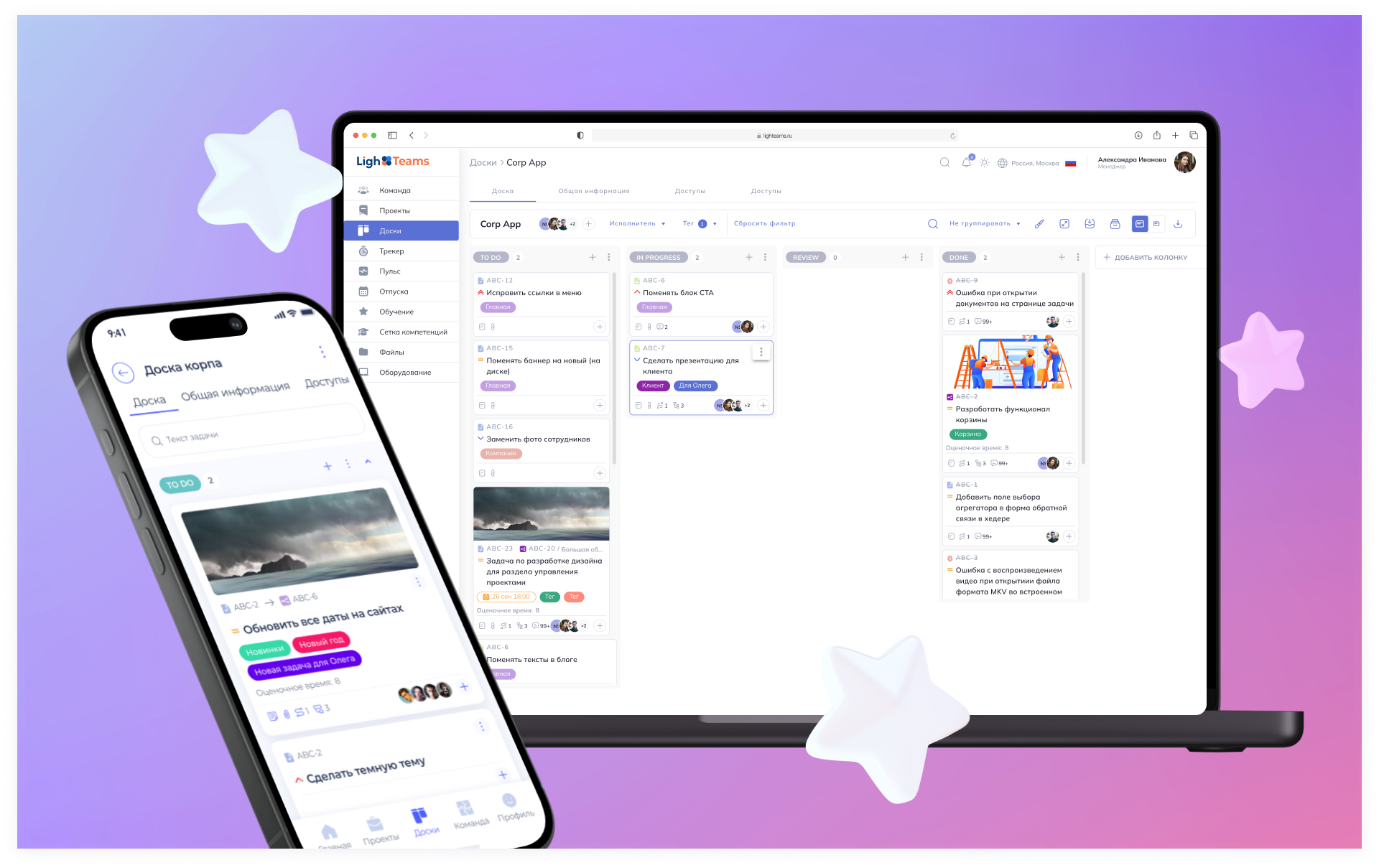
LighTeams is a business process automation system that helps to put tasks in order, simplify team work, and make delegation convenient and secure. We've tested it on ourselves, and now we're sharing it with others.
1. Formulate the goal and result of the task.
2. Select an artist based on their skills and workload.
3. Set deadlines and milestones.
4. Attach the instructions and access points.
5. Motivate — and don't interfere with creativity.
6. Monitor progress — without micromanagement, using a dashboard.
Delegation has a simple logic:
I do it myself
Ready to delegate
Delegated
Without the first stage (personal understanding), it is difficult to delegate responsibility. For example, if you don't know how to measure results in marketing, you won't be able to assign a task to a specialist. Therefore, it is important to understand at least at a basic level — so as not to transfer "everything in a row", but to manage the process consciously.
Effective delegation is the ability to distribute responsibility and support a team. And business process automation systems are your tools to organize teamwork, automate processes, train employees and not lose control. Even if you fly to the Caribbean, everything will work.At first, everything seems to be working. But as soon as the team grows, parallel tasks, vacations, and onboarding of new employees appear, the "manual" management stops coping. Modern automation systems for managing the company's employees help to distribute tasks, record progress, not lose information and speed up work. It's a matter of efficiency.