Modern digital products are developing very fast. New features are released every week, and sometimes several times a day. At the same time, the volume of checks that must be performed before the release is growing.
Manual software testing helps to control the quality of the product, but with a large number of changes, its capabilities are no longer sufficient. Even automated tests require constant maintenance: after updating the interface or business logic, some of the scripts have to be rewritten and adapted anew.
That's why companies are increasingly using artificial intelligence in QA. In this article, we will look at what tasks AI is already helping QA teams solve and how it is used in test automation.
According to market analysts, about 40% of companies are already using AI in testing — and this is just the beginning. Approximately 80% of development teams will integrate AI tools into QA processes in the coming year.
Also at the peak of popularity is a new class of systems — AI/ML/LLM solutions, whose behavior is fundamentally different from conventional software. They cannot be tested using traditional QA methods: they do not produce a deterministic result.
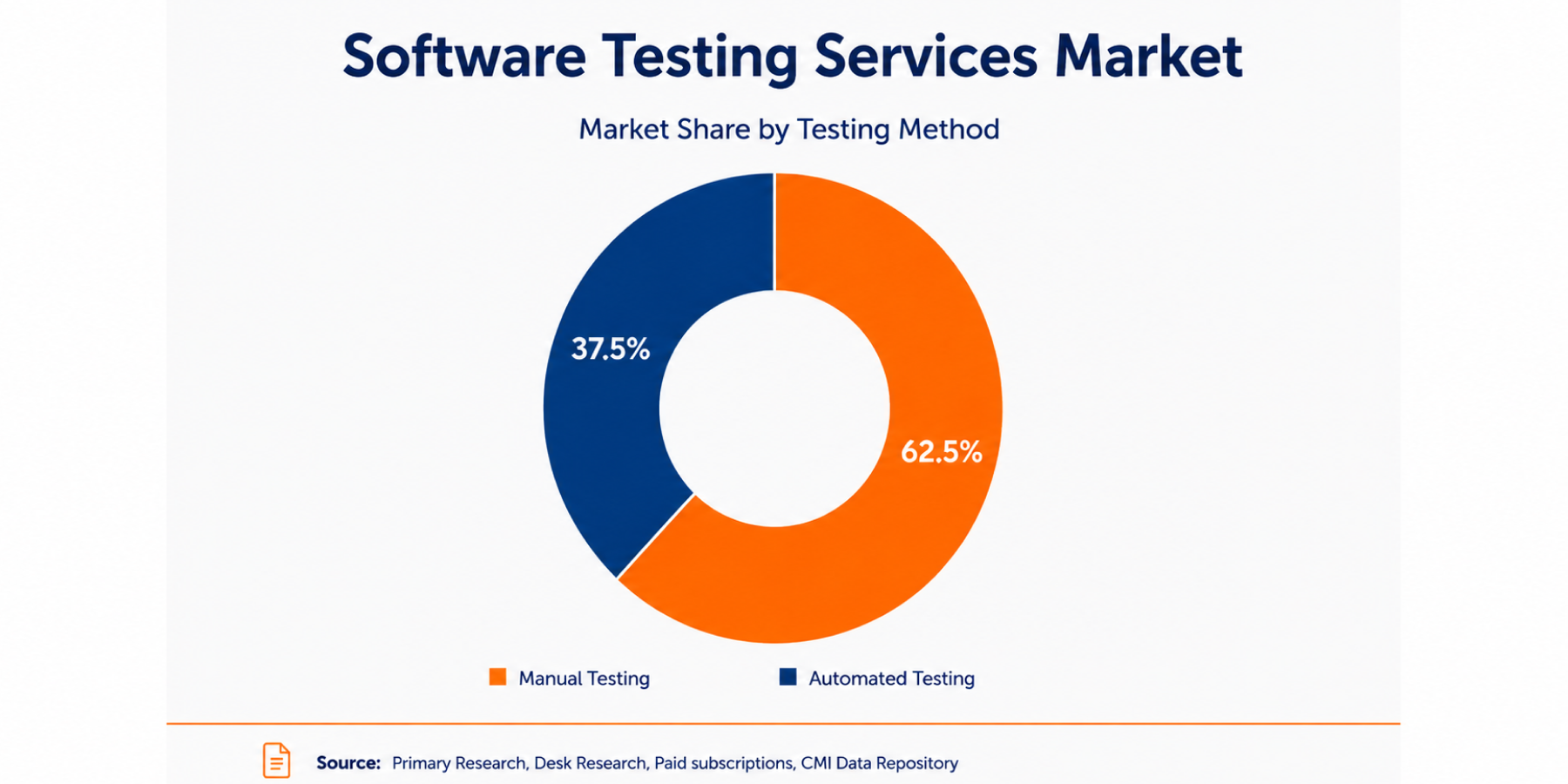
However, the development of automation and artificial intelligence does not mean the end of manual testing. By 2026, manual testing is expected to account for approximately 62.5% of the market, while automated testing is expected to account for the remaining 37.5%.
Manual testing remains the most effective method for identifying complex user interface issues, usability flaws, and non-standard user behavior scenarios that automated tools may overlook.
Compared to traditional automation, the results look like this:
- the accuracy of defect detection increases from about 76% to 90%;
- completeness of the test coverage — from 82% to 95%;
- Test development and execution time is reduced by about a quarter.
The total cost of testing is also reduced to 25%.
Machine learning models are better at finding hidden dependencies in the behavior of the system — those that a person simply won't notice during manual verification. This is especially evident when searching for complex defects related to rare scenarios or system conditions.
Automating the generation and launch of tests using neural networks reduces the labor required to maintain the test base and speeds up the entire verification cycle.

QA tasks consume an average of 25% of a company's IT budget. Most of these costs are not for complex tasks, but for routine:
Tasks that used to require days of manual preparation are now completed in minutes. AI automation reduces the cost of maintaining the test base to about 70%.
The tasks that can be assigned to AI are described below.
|
AI function |
What automates |
Type of testing |
|
Generating test cases |
Creates validation scenarios based on requirements, layouts, and API documentation. Allows you to prepare tests 3-5 times faster than manually. |
|
|
Self-updating tests |
Automatically updates tests after interface changes, reducing the amount of manual support. |
Regression, end-to-end (end-to-end) |
|
Generating autotests and code |
Analyzes the application and creates ready-made autotests for web and mobile applications |
Functional, API, End-to-end |
|
Prioritization of defects |
Determines which errors are most critical for users and businesses, so that the team fixes them first. |
Any type of testing |
|
Analysis of logs and anomalies |
Automatically searches for the causes of failures, identifies unstable system operation and suspicious deviations. |
|
|
Automatic interface verification |
Checks the appearance of the interface and finds visual errors after updates |
Usability, regression |
|
Generating tests based on the description |
Creates test cases based on requirements in natural language |
|
|
Synthetic test data |
Generates secure data for system verification |
Load, integration, and security testing |
|
User behavior analysis |
Identifies problematic scenarios and user failure points |
A/B testing, usability, UAT |
|
Generating unit tests |
Creates checks for individual components and modules of the system |
Analysis of QA processes
First, the team looks at how testing works now: what tests are there, how the regression goes, how long the release takes, and where delays occur.
At this stage, it is determined which parts of the process are most profitable to automate.
Generating test cases
Based on the requirements, design, and API documentation of AI, the structure of test cases is formed: prerequisites, steps, and expected results. Additionally, scenarios for smoke, regression, and end-to-end testing are generated, taking into account the logic of the product.
Generating autotests and code
Stabilization and review
Integration into CI/CD
Autotests are connected to the CI/CD pipeline for regular automatic startup. The team receives documentation, a coverage structure, and a ready-made solution for further scaling.
When releases occur weekly or daily, performing a full regression manually becomes increasingly difficult. Using AI to automate the process helps create and maintain tests faster, allowing the team to check more changes in less time.
Instead of increasing the number of testers in proportion to the volume of work, the company can scale quality control processes through automation.
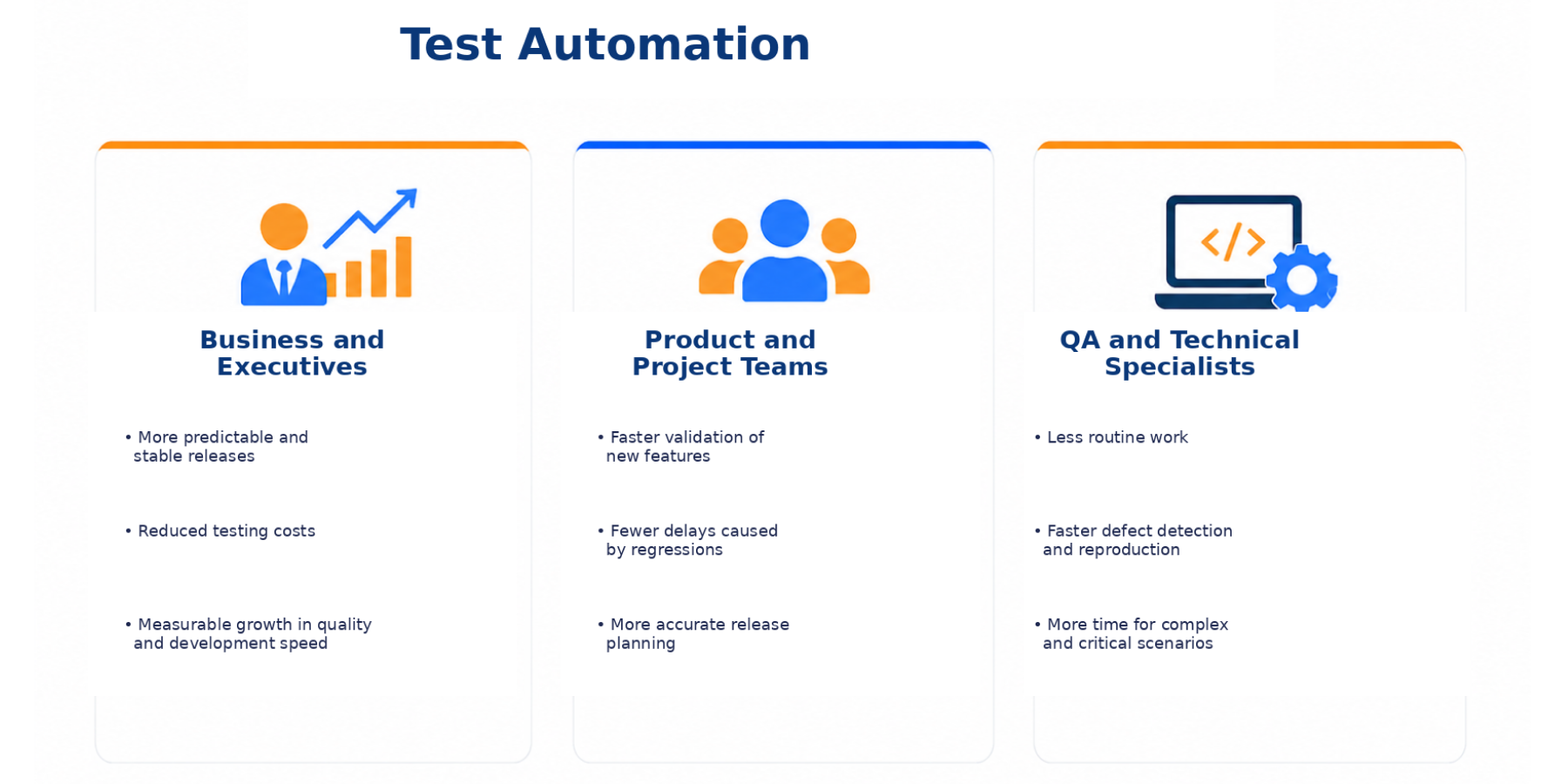
What results can be obtained with the introduction of artificial intelligence:
If your product uses artificial intelligence, regular functional testing is no longer enough. The model can work correctly from a technical point of view, but at the same time give inaccurate answers, invent facts, respond differently to the same requests, or make mistakes in non-standard scenarios.
In traditional development, most errors are related to the application logic and are usually fixed after the code is fixed. In AI systems, everything is more complicated: the quality of work depends not only on the algorithms, but also on the data on which the model was trained, its settings and operating conditions.
When testing AI solutions, it is important to check several key parameters:
The accuracy of the responses is how well the results match the expected data and business requirements.
Resilience is how the model handles non—standard, incomplete, or ambiguous queries.
Model drift — whether the quality of work is maintained over time when data and user behavior change.
Hallucinations and generation errors — whether the model is inclined to give out unreliable information as a reliable fact.
The stability of the results is how predictably the model responds to similar queries.
Explainability of solutions — whether it is possible to understand the causes of errors and identify patterns in the operation of the model.
That is why separate testing methods are used for AI, ML, and LLM solutions, which take into account the specifics of the models and help identify problems even before the product is released into production.
Fixing problems after the launch of an AI product usually costs significantly more than detecting them at the testing stage. Model errors can lead to loss of user trust, financial losses, and additional costs for system improvements.
Classical automation requires manual writing and constant test support. AI tools generate scenarios automatically, adapt to product changes, and prioritize defects without the involvement of an engineer.
Yes. The vendor is testing the model on their own data and in their own conditions. You are responsible for its behavior in the real scenarios of your product — with your data and your users.
If the company does not have dedicated testing specialists yet, it is not necessary to immediately form a full-fledged QA department. To start quality control processes, you can hire a QA engineer in the outstaffing format and quickly strengthen the team for current tasks.
So you can: