

We live in a time when artificial intelligence is no longer just for big technology companies. All companies can use artificial intelligence in their digital solutions. This is important for their survival in the market.
In this article, we look at what has caused AI to be introduced and what results this will produce.
The integration of artificial intelligence (AI) into an organisation refers to the incorporation of machine learning algorithms, neural networks, and associated technologies into the organisation's existing processes, products, and decision-making systems. AI is no longer just an IT experiment – it's now a key part of how we do things every day.
It is important to understand the difference between automation and AI integration. Classical automation follows strict rules: "If A, then B" is the way it works. An AI system learns from data, adapts to new situations, and improves its own predictions over time. This is a whole new level of possibilities.
AI integration is not about replacing employees, but about making their skills better. People decide what is important to them and what to do. AI processes the data, identifies patterns, and suggests options.
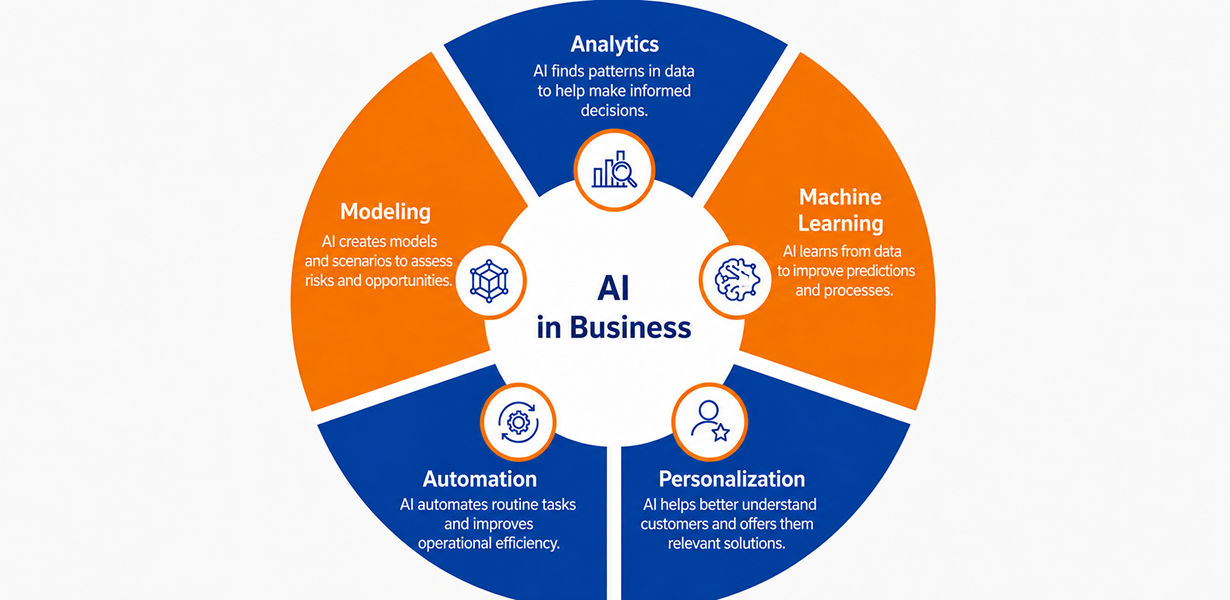
There are three reasons why the introduction of AI is necessary for most organizations.
Businesses generate huge amounts of information, from sales to user behavior. Conventional analytics can no longer cope, but AI can quickly process and combine different types of data.
The market is constantly changing. Annual planning is becoming obsolete — now it is important to analyze the situation and adjust actions in real time.
AI companies work faster, more accurately, and more cheaply. Those who delay implementation are falling further behind every month.
The terms "artificial intelligence", "machine learning" and "neural networks" are often used to mean the same thing, but there is a clear difference between them.
|
Technology |
Description |
Application examples |
|
Artificial Intelligence (AI) |
A broad field is any system that copies what people can do. |
Chatbots, recommendation systems, voice assistants. |
|
Machine Learning (ML) |
Algorithms that learn from data without being programmed to do so. |
Predicting which customers will leave, how likely they are to do so, and how much sales will drop. |
|
Deep learning / neural networks |
Using multiple layers of neural networks allows you to process complex data. |
Image recognition, NLP, content generation. |
|
Natural Language Processing (NLP) |
The process of analysing, understanding and creating human language. |
Review analysis, automatic preparation of reports, document management. |
|
Optimization algorithms |
Look for the best solutions in areas where there are a lot of different variables. |
Supply chain optimization, resource planning, portfolio balancing. |
AI takes on repetitive tasks: processing applications, data reconciliation, reports, and query allocation. This applies not only to production, but also to office work.
As a result, employees spend less time on routine tasks and more on tasks where thinking and communication are important. The result: lower costs and faster processes.
Previously, decisions were based on past experience. AI allows you to look ahead and see the risks in advance. The systems analyze the data, find patterns, and warn of possible problems.
You can better understand each client: what they need, when, and in what format.
Recommendations, behavior analysis, and working with reviews all help to retain customers.
Instead of intuitive conclusions about budget allocation, optimization algorithms are used that minimize the cost of attracting one customer and maximize ROI for each channel.
Predictive models predict market trends, identify patterns of consumer behavior, and determine the optimal moments for communicating with each specific user.
HR is one of the most promising, but also the most sensitive areas. AI accelerates recruitment and work with staff: it helps to select candidates, predict turnover, and simplify the adaptation of new employees.
People still do the main work, which is important both from a business point of view and from an ethical point of view.
One of the fastest growing areas is the use of AI in the tools that employees work with every day. There are three technologies that form a chain here: knowledge capture, smart search and corporate memory.
Each meeting automatically becomes part of a common knowledge base: the system stores information and is able to search for meanings rather than keywords.
The synergy of RAG and the AI knowledge base is the "corporate brain" available to any employee at any time. A new employee gets access to the company's accumulated experience over the years, and an experienced specialist gets instant search through thousands of documents.

AI helps companies spot risks more quickly and move from reacting to preventing problems. It can also cut the cost of everyday processes by 20-40% and help companies to use their resources more efficiently.
Let's take the case of our team at LighTech as an example. A large logistics company in the B2B segment: after the introduction of an AI operator based on the RAG architecture, the time for calculating the cost of transportation was reduced from 15-30 minutes to 1 minute, and the system began to process 80% of standard requests without the participation of managers. The team switched to complex transactions instead of routine ones.
The experience of leading organizations shows that the success of AI integration is determined not so much by the choice of specific technologies as by the company's willingness to systematically change approaches to data and employee training.
Trends for the coming years point to deeper integration: from isolated AI solutions to end-to—end intelligent platforms covering the full management cycle.
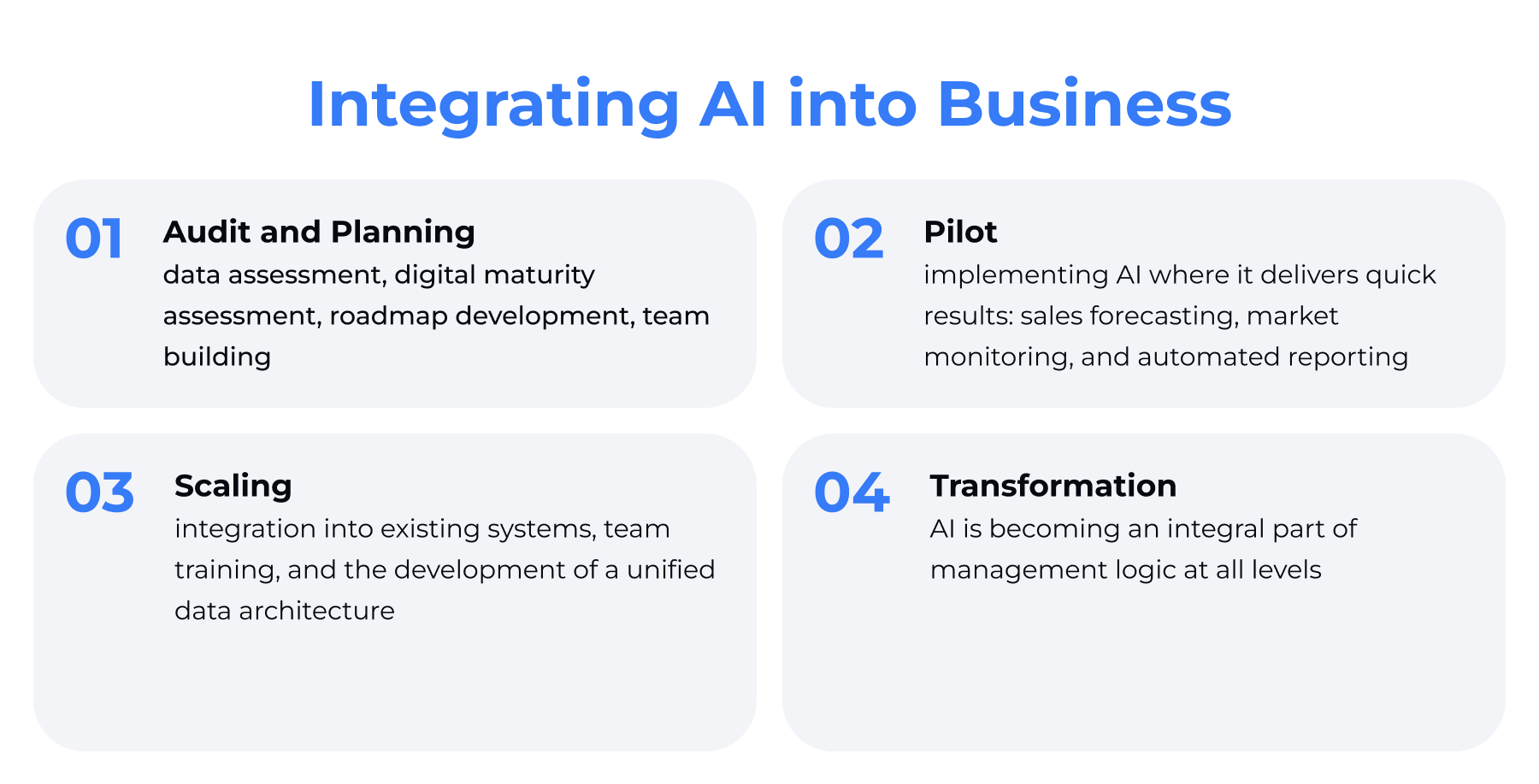
Start with an audit: which processes take the most time and are of the same type. That's where the fastest returns from AI come from. The first pilot should not be large-scale: one task, one department, a measurable result.
No, but it will change what they do. Routine, repetitive operations go to the machine. People switch to tasks where judgment, communication, and context are important: complex transactions, unusual situations, and strategic decisions.