Video surveillance systems for businesses have long been an integral part of the security infrastructure, from small shops to international airports. However, even the most modern camera by itself does not guarantee the result. The real threat is often noticed too late: a person is physically unable to track hundreds of video streams, and manually searching for the necessary fragments in hours of archived recordings means wasting a lot of time.
This task is solved by modern video analytics, a technology at the junction of artificial intelligence and computer vision. They turn cameras into active participants in the process: they "see", "analyze", and instantly react at the right moment. And that's exactly what our article is about.
Video analytics is a technology for automatic analysis of a video stream in real time. It allows the system to:
detect people and objects;
recognize faces, car license plates;
tracking behavior;
detect suspicious activity;
promptly notify those responsible.
A neural network in video analytics systems is a learnable algorithm that recognizes objects based on repeated analysis of examples. After training on a set of images, the neural network can independently identify the studied objects, but within a strictly defined framework of its training.
For example, neural network video analytics recognizes the absence of a helmet on an employee, but does not specifically identify the cap as an alternative headdress — it only sees "no helmet". When implementing such systems, it is important to understand their limitations: the neural network performs highly specialized tasks efficiently, but does not have universal intelligence comparable to human intelligence.
Unlike classical video surveillance, where the operator needs to independently monitor everything that is happening, video analytics works differently - the "smart" system itself notices that something is wrong and reports it.
Video analytics systems in the company's video surveillance work not only as the "eyes", but also as the "brain" of security. They record what is happening, interpret, classify, and draw conclusions based on the behavior of objects and the context. Below are the functions of the video surveillance application, which are indispensable in business, transport, urban services and other areas.
|
Function |
Description |
|
Object detection |
Identification of people, cars, animals, and other objects |
|
Tracking |
The system monitors the movement of objects with the assigned ID |
|
Face and number recognition |
Search and identification of people and cars |
|
Crowd and behavior analysis |
Detection of anomalies, suspicious activity, fights and conflicts |
|
Classification of objects |
Division of objects by type (car, person, equipment, etc.) |
|
Audio and text analytics |
Recognition of sounds, speech, barcodes, and texts |
|
Counting and statistics |
Counting people, cars, and events |
|
Comprehensive scenario analysis |
Comparison of data from different sources and forecasting |
The main functionality of camera video analytics allows you to monitor, manage what is happening and prevent incidents before they develop and make more accurate decisions based on the data.
Modern intelligent video analytics systems are based on two basic architectural principles:
Edge analytics — data processing takes place directly on devices (cameras or recorders). This reduces the load on the network and allows you to react faster to events.
Cloud solutions — video is transmitted to a server, where powerful computing resources and AI modules are used for analysis. This approach is scalable and convenient for remote access.
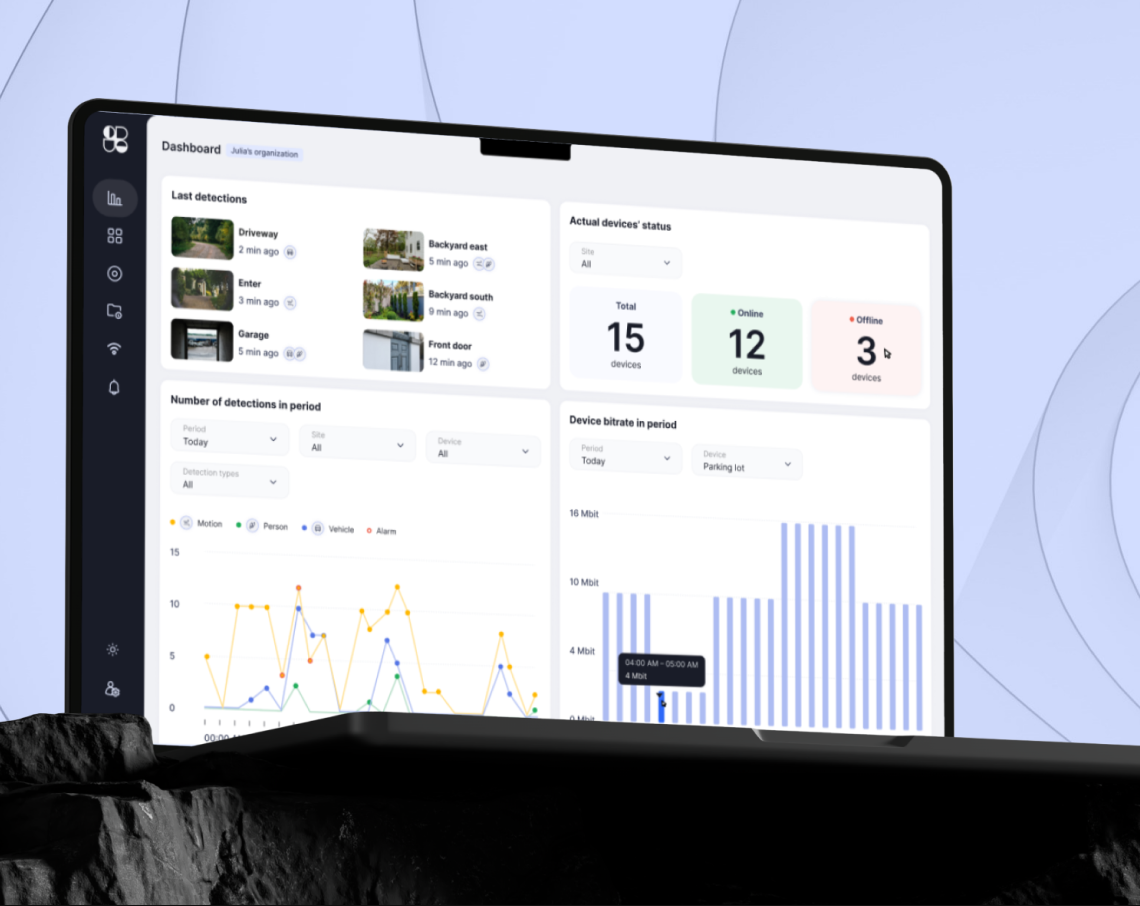
The CORVID project, developed by LighTech for a technology company specializing in security solutions, combines AI analytics, mobile video surveillance and cloud data storage.
The customer's goals were as follows:
Ensure stable real-time monitoring.
Integrate the solution with the existing infrastructure.
Provide remote access via the web and mobile application.
Use video analytics to automatically detect incidents.
We have developed a cloud-based video surveillance system with video analytics with the following parameters:
Cross—platform - works even on IoT devices and microcontrollers.
Supports RTSP and ONVIF standards for compatibility with most cameras.
Intelligent agents identify suspicious actions and evaluate behavior.
Remote connection — Cameras can be added from anywhere without port forwarding.
Flexible architecture — suitable for both private and corporate applications.
The CORVID video surveillance analytics system has been successfully used in business, retail, the public sector, and even for personal use, combining security, simplicity, and powerful analytical tools in one solution.
Modern video analytics is part of an ecosystem of smart solutions that transform business processes, security, and management. It combines AI, big data, and Internet of Things technologies into a single analysis tool.
Areas of application:
Situational analytics — detection of intrusions, crashes, conflicts, and emergencies.
Technological analytics — control of production processes, monitoring of logistics operations.
Biometric analytics — face and license plate recognition, automation of access control.
Business analytics — heat maps, customer routes, marketing and operational insights.
There is a choice between ready-made universal solutions and individually designed systems.
Universal products are introduced faster and cost less, but they often do not take into account the specifics of a particular business. Customized solutions, although they require large initial investments of time and money, provide 20-50% higher quality of analysis, which is critical for retail and industry.
|
Approach |
Advantages |
Disadvantages |
|
Ready-made solutions |
Fast startup, low cost |
Limited adaptation |
|
Individual development |
High accuracy, consideration of specifics |
Longer and more expensive |
Before implementing video analytics systems, you need to define the main tasks. For example, theft prevention with automatic replenishment of the database of violators or optimization of the display of goods. Any use case relies on five basic functionality:
object detection and classification;
identification of specific objects or persons among similar ones;
localization with assignment of a unique ID and continuous tracking;
identifying patterns in large amounts of data and predicting potential events based on historical information.
Video analytics demonstrates maximum efficiency when integrated with other IT systems - access control, security systems, ERP/CRM, IoT devices and business intelligence platforms, which allows you to automate routine processes and free up human resources.
Task and threat analysis
At the first stage, it is determined which events or objects need to be monitored: intrusions, unauthorized access, lack of personal protective equipment, crowds of people, non-standard behavior.
Architecture design
A technical solution is being formed: where the video will be processed (locally or in the cloud), how many cameras, which analytical modules are needed, and how scalability and fault tolerance are ensured.
Selection of equipment and platforms
Cameras (with or without analytics support), video recorders, network components, cloud capacities, as well as software modules are selected: from basic analytics to neural network models.
Integration with the IT environment
The system connects to other tools: CRM, ACS, security panels, mobile applications, and internal BI services. Compatibility via RTSP, ONVIF, API and SDK is taken into account.
Setting up analytics and training
Testing
Conducting functional, UX, and load testing of software at all stages. Ensuring high stability and compliance with industry requirements.
Gradual scaling
The system is used in logistics and transportation to monitor routes, load/unload, and identify abnormal situations in warehouses and terminals. In production, video analytics is needed for face recognition and PPE, safety monitoring, and process analysis. In retail, video analytics systems are used to count visitors, analyze behavior, build heat maps, and optimize layout.
The cost depends on the complexity — the number of cameras, analytics functions, security requirements, and platforms (iOS, Android).
For example, an MVP mobile application for controlling cameras, watching videos, and receiving alarm notifications can be created using the Flutter cross-platform technology to enter the market faster and cover the iOS and Android platforms simultaneously.