LighTech
Home
/
Blog
/
Automation
/
Digitalization of retail

Retail digitalization: routine automation and implementation of AI solutions

Digitalization of retail

In grocery retail, the speed of decision-making directly affects money. If the product is purchased too late, the shelves become empty, and sales are lost. If the demand is overestimated, there are still surpluses in the warehouse, which then have to be written off.

According to industry research, out-of-stock losses in retail can reach 4-8% of the category's turnover. To avoid such a situation, the company needs to build processes.: synchronize purchases and sales, monitor the budget in real time, and work with data. In this article, we'll look at how retail digitalization helps minimize losses and speed up management decisions.

How to deal with management issues in retail?

Digital retail solutions help identify and eliminate bottlenecks that lead to financial losses. They record data on purchases, balances, delivery dates, and sales, allowing them to quickly notice deviations from planned targets. This works with centralized data storage and regular updates. For example, a BI system can detect an increase in write-offs for a specific product category or delays from a specific supplier.

The following are examples of what retailers most often encounter in the course of their work.
 

1. Fragmented supply chains

In large networks, suppliers, warehouses, and stores operate through different channels: mail, spreadsheets, and messengers. This creates confusion, delays, and data loss. The development of a retail platform will unite all participants into a single system where purchases, approvals, delivery statuses and documents are in one loop.
 

2. Lack of control over the procurement budget

When orders are generated in different departments, there are overspending, duplication of items, and inconsistent purchases. The centralized system allows you to see the limits in real time, compare the plan and the fact, monitor deviations and analyze costs.
 

3. Overloaded managers and the human factor

The dependence of operational processes on a single manager increases the risk of errors and delays. Manual processing of applications and reconciliation of invoices may result in errors and lengthy approvals. The risk is particularly high in the absence of regulated digital approval routes. Automated systems distribute tasks and record statuses, reducing dependence on a specific employee.
 

4. Lack of analytics

It is difficult to assess effectiveness without analytical tools.: which suppliers break deadlines, which categories make the most profit, and where losses occur. Modern systems display this data in an understandable way.
 

5. Risks of supply disruption

Working with unverified suppliers or the lack of a history of interaction leads to delays and losses. This can be avoided by keeping a register of suppliers, keeping a history of cooperation, and automatically reporting violations.
 

6. The complexity of assortment management

In retail, the product range can include tens of thousands of items. Product data may be duplicated, discrepancies in the cards and erroneous orders may appear. The unified NSI database (regulatory and reference information) eliminates duplicates and ensures the correctness of information for all divisions of the network.

The RAG system (Retrieval-Augmented Generation)— an enterprise AI that works with internal company data, can also help here.


RAG connects to the NSI database, regulations, internal instructions, and change history. When an employee asks a question, the system finds relevant information and generates an accurate answer based on your documents.


For example:
 

"Is there already such a position in the database?"
 

"What are the required fields for the dairy product category?"
 

"Why was the product blocked?"
 

The employee receives a response in seconds, without correspondence with colleagues and manual search. As a result, there are fewer errors, faster approvals, and a lower workload for managers. We wrote more about how to implement RAG in business in the article.

7. Slow order processing

If purchases go through mail or spreadsheets, the process is delayed for days. This is critical for high-turnover retailers. The online platform with automatic approval routes significantly reduces the processing time of applications.

Three levels of retail digitalization: automation, AI and personalization

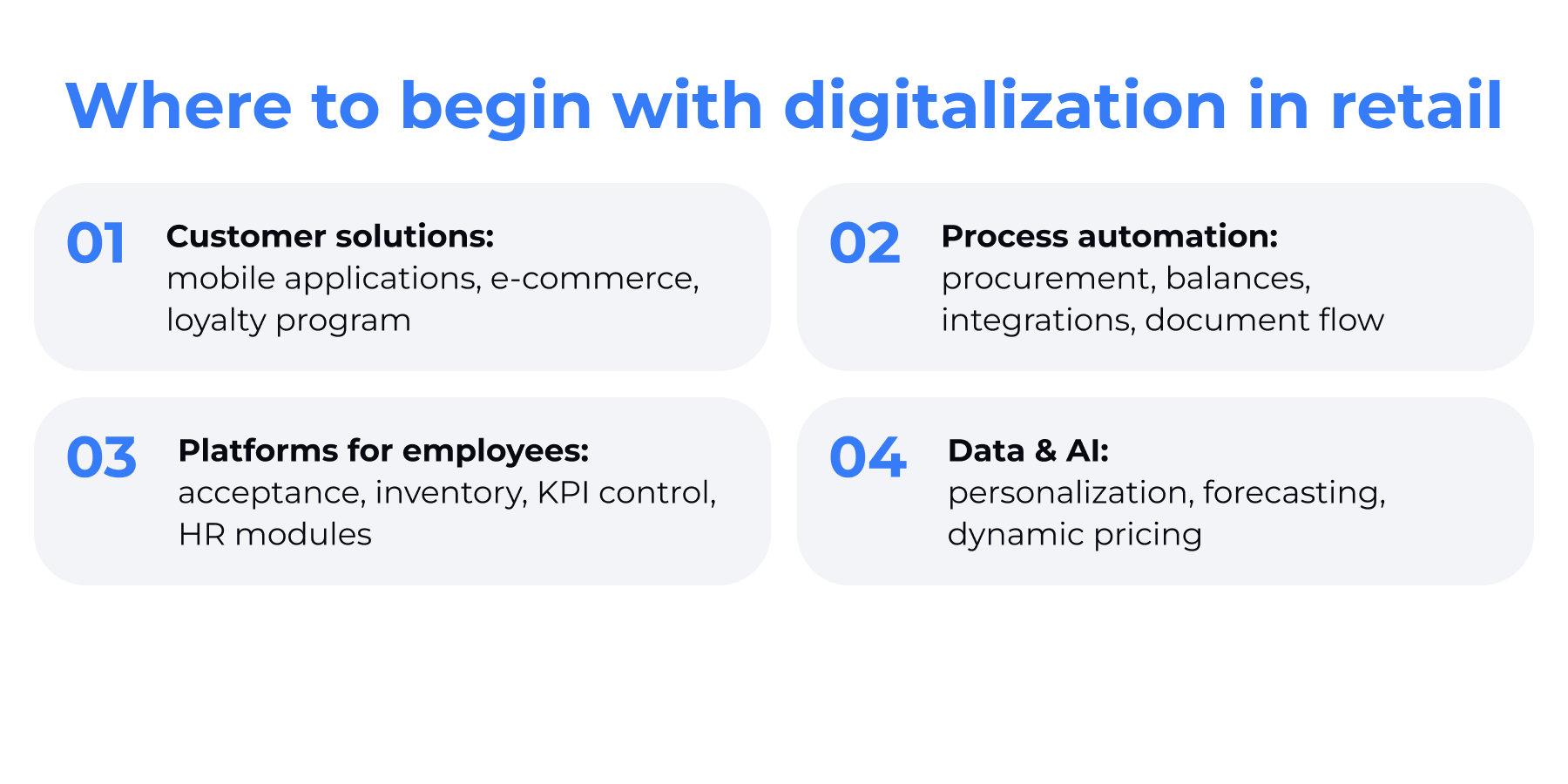
Digitalization in retail is moving in three directions: automation of routine, implementation of AI solutions and personalization for customers. Automation reduces transaction costs, AI improves forecasting and management, and personalization increases conversion and repeat sales.


1. Automation of routine processes

In retail, a significant part of operations is repeated: accounting for balances, order formation, logistics, refunds, and customer support.

Automation closes these tasks at the system level.:

  • The balances are tracked automatically, and the order to the supplier is formed without the participation of a manager.;
  • delivery is distributed among couriers according to the set rules;
  • typical customer requests are processed by a chatbot.

If the product is approaching the minimum balance, the system analyzes sales and seasonality and generates a purchase in advance. This reduces the risk of out-of-stock and prevents excess inventory.

For purchases, the following are used:

  • electronic trading platforms — digital execution of tenders and orders;
  • SRM systems — management of suppliers, conditions and indicators of their work;
  • The P2P (Procure-to-Pay) model is an end-to—end process from application to payment in a single loop.

As a result, the purchasing and operating cycle becomes manageable and transparent.

Automation is not about reducing people. It's about reallocation of resources. Employees stop doing mechanical work and switch to tasks that affect sales growth and customer experience.

2. AI for management

If automation simplifies processes, then AI begins to manage them. Stores use it to better understand customers, save on logistics, and sell more. Moreover, this works not only for major players like Amazon, but also for regular networks.

Artificial intelligence in retail is applied in three key areas.


The use of AI in retail

How it works

Forecasting demand

Algorithms analyze sales history, seasonality, promotions, customer behavior, weather, holidays, and external trends to predict the volume of demand for days, weeks, and seasonal peaks.

For example, Magnit uses ML models to predict demand for tens of thousands of SKUs, taking into account regional specifics.

Personal recommendations

The system studies the purchase history and user behavior in the app or on the website, forming individual offers. This increases the average receipt and the frequency of purchases.

Such approaches are used by Amazon (recommendations based on large amounts of data), Sephora (selection of cosmetics according to the client's profile) and Yandex.Market (personalized product feed).

Operational efficiency

AI optimizes delivery routes, staff schedules, analyzes cash registers and video surveillance data to identify anomalies.

3. Mobile or web application in retail

Personalized recommendations in mobile and web applications can increase the average receipt and the frequency of repeat purchases. The system analyzes the purchase history and suggests relevant products or complementary items. As a result, marketing costs are reduced, the average receipt is higher, and customers return for repeat purchases.

The LighTech team has implemented a mobile application for sales consultants of a large jewelry chain from the top 5 of the Russian market (more than 300 stores).


The app collects the purchase history of each client and, based on it, tells the consultant what to offer.:
 

- Did the client buy gold earrings? The system will show matching pendants and rings in the same style.
 

- Does a person prefer classics? It will not offer avant-garde models.
 

- Does the buyer focus on a certain price segment? The consultant immediately sees relevant options.
 

The result: the average receipt increased, additional sales increased, and most importantly, customers stopped leaving with the phrase "nothing came up." Just because they were shown exactly what they needed.
An application for a jewelry retailer from the top 5 (NDA)
webmobile
A mobile solution for jewelry chain sellers
С чего начать цифровизацию в ритейле

Do you want to know how much it costs to develop a digital platform for retail?

We will analyze your supply structure, procurement processes, assortment management and analytics, and propose a solution that will cover operational risks and meet your budget
Discuss the project
LighTech

The Internet of Things in retail

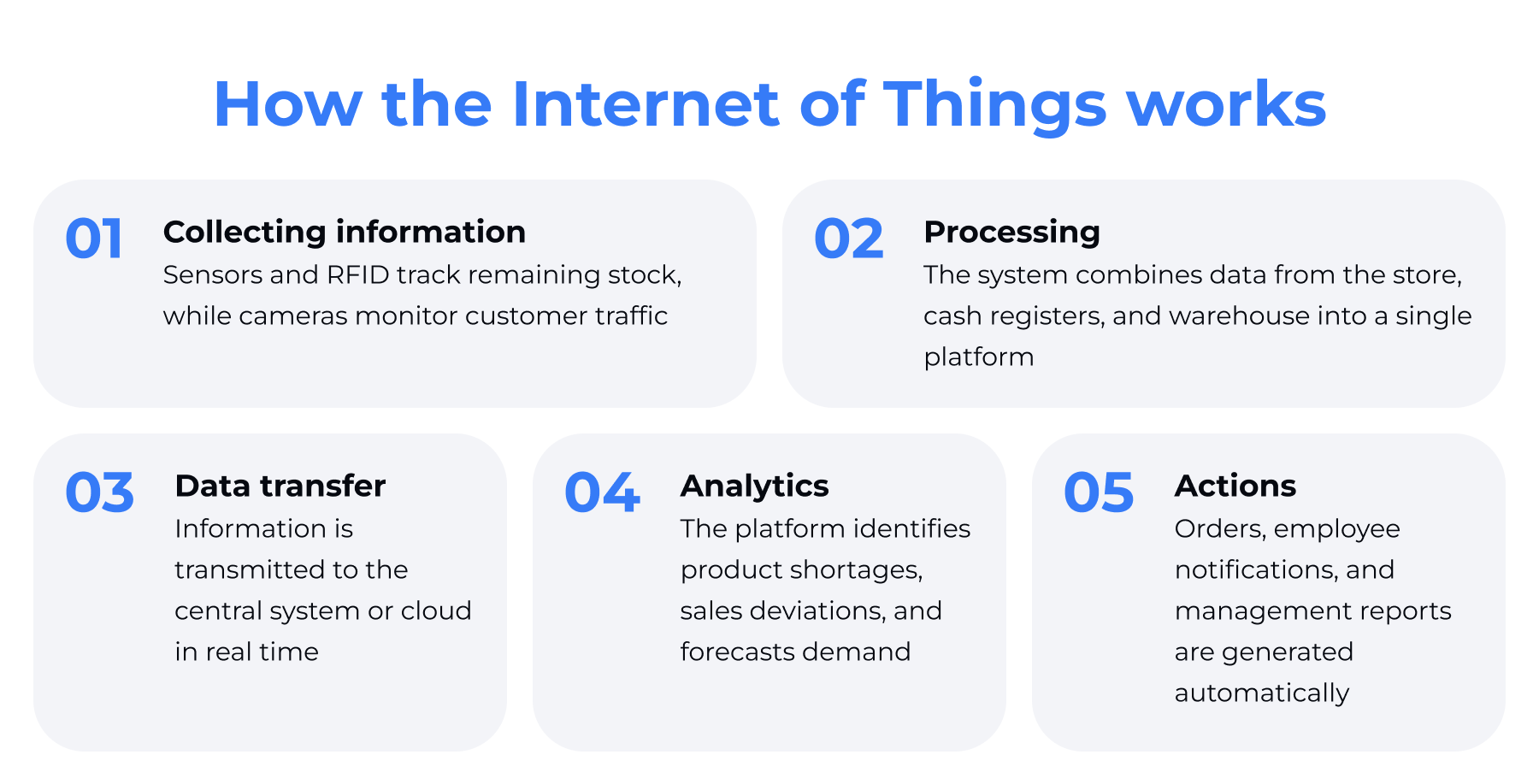
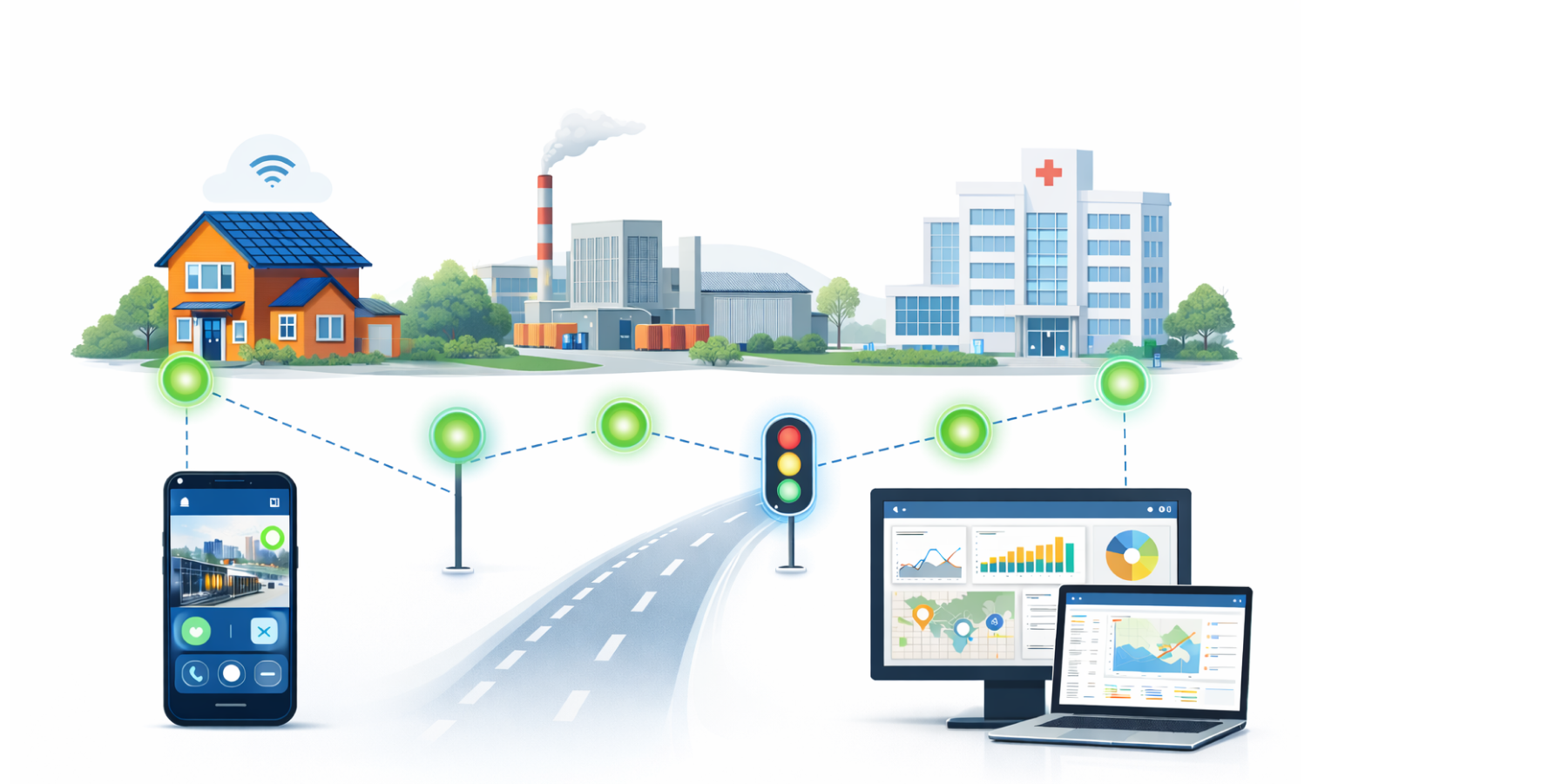
Today, the Internet of Things (IoT solutions) is also becoming increasingly popular in retail. Smart shelves, sensors, video cameras, and tracking devices allow you to automatically monitor the availability of goods, analyze customer behavior, optimize logistics, and personalize service.

Как работает Интренет вещей в ритейле

The Internet of Things is growing along with devices and analytics, which is a tool for digital transformation. The business makes decisions based on the collected data and gains an advantage over competitors.

Digital technologies as a way to reduce costs and increase revenue

Even a simple operation, for example, replacing a paper price tag, turns into serious labor costs on a network scale. It takes an average of about a minute for an employee to replace one price tag, taking into account printing and placement. In terms of the store, these are dozens and even hundreds of hours per month that employees spend not on working with customers, but on routine.

And if we introduce digital technology? The price is updated automatically, stocks are highlighted immediately, errors due to "forgotten" replacements disappear. As a result, the staff is freed up for tasks that affect sales: layout, consulting, assortment control.

The main barriers to retail digitalization are concerns about the complexity of implementation and costs. But the approach can be built in stages: launch a pilot in several stores, measure the effect on operational performance, and only after proven effectiveness can we scale.

Offline retail will not go anywhere, but its format will change. The trading floor will become more technologically advanced: more automation, more analytics and more personalization — without losing the experience familiar to the buyer.

Frequent questions

How to link automation, AI and IoT in retail?
What steps are needed to benefit from the introduction of modern solutions in retail?
What retail technologies are suitable for medium and small businesses?
Who is suitable for developing digital solutions for retail?

Share

Discuss the project with the LighTech team

Book an appointment

Our projects

Tell us about your project
Name
Contact
Message
Attach file +
Request to get files
Name
Send files
Message
Thanks!
Your request has been sent
After processing, our manager will contact you