LighTech
Home
/
Blog
/
Automation
/
How to automate B2B sales with AI

How to automate B2B sales with an AI operator and not mess up

How to automate B2B sales with AI

Sooner or later, every sales manager asks himself one question: why are managers busy all day, yet leads still go to competitors?

The issue isn’t that the sales team isn’t working hard. The real problem is how their time is spent. Instead of selling, much of the day goes to preparation: recalculating pricing, clarifying request parameters, drafting standard replies, and entering data into the CRM.

Slack recently shared an interesting insight: over a six-month period, the use of AI in everyday office workflows increased by 3.5× (+233%). Employees who use AI tools daily report higher productivity and greater job satisfaction. They process information more quickly, allocate less time to repetitive tasks, and steer clear of operational work.

In this article, we show how to speed up lead processing and integrate AI into B2B sales to achieve measurable results.

Why are B2B companies losing customers?

In B2C, the logic is simple: if you miss the call, you lose the customer. In B2B, it works a little differently. Missed calls rarely lead to lost deals; instead, slow response times do.

Imagine a client sends a request for a quote. If your proposal arrives an hour later, chances are they’ve already reached out to two or three competitors. And most often, they’ll go with the one who responded first.


What does a typical manager's day look like?

Take a logistics company as an example. Most incoming requests are routine inquiries from regular customers—calculating transportation for familiar routes, similar cargo, and comparable shipment volumes.

Each time, the manager does the same thing:

  • clarifies the parameters;
  • recalculates the cost using the formula;
  • checks the data;
  • generates and sends the response.

If each request takes 10–15 minutes to process, that adds up to dozens of hours of routine work every week. During peak periods, the backlog grows: responses slow down, new customers wait longer, and some simply move on to competitors. Most companies don’t even realize how much business they lose because of it.

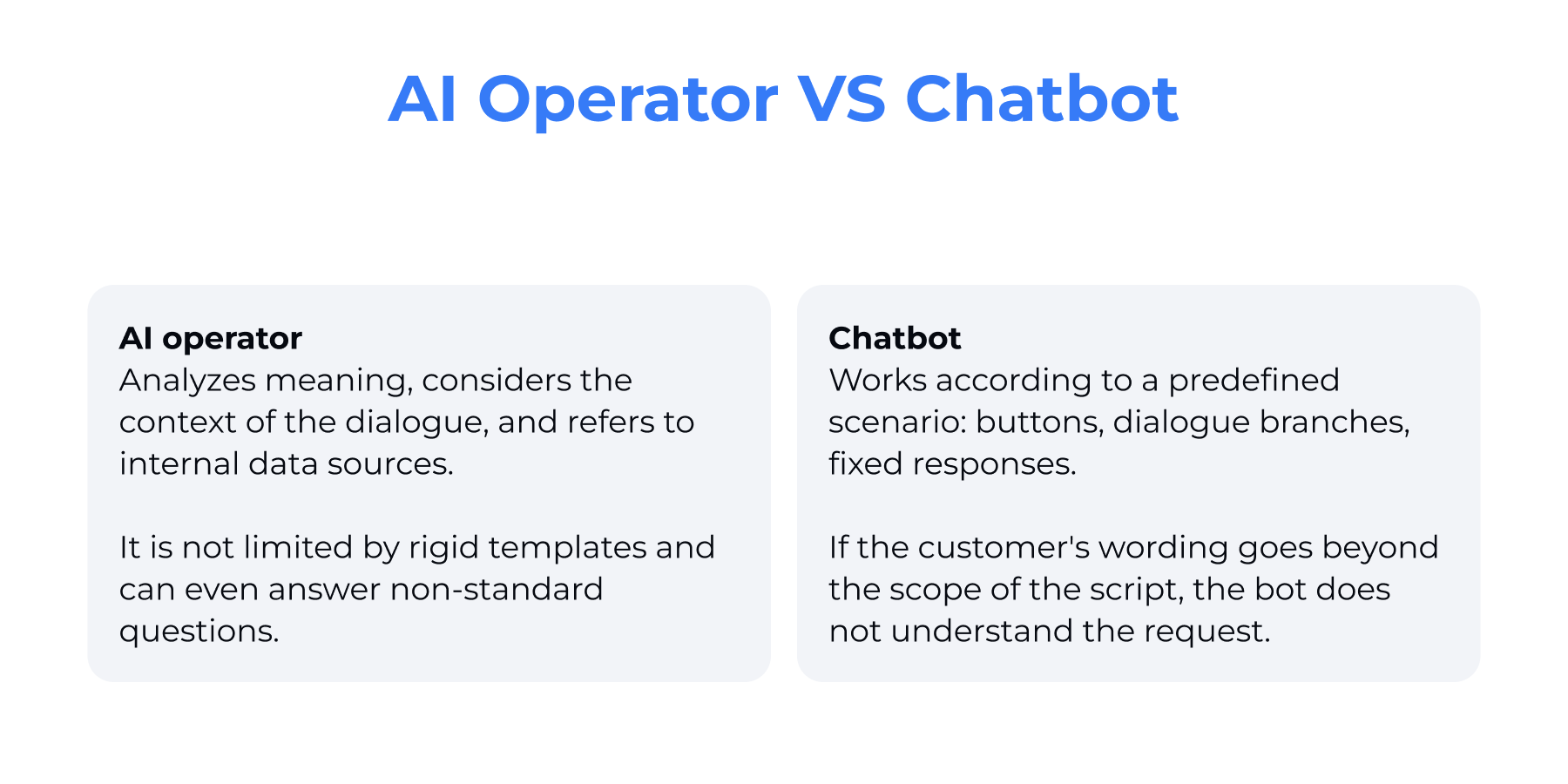
What is an AI operator and how does it differ from a chatbot?

An AI operator is not a chatbot with prewritten answers to common questions. It’s a managed digital employee embedded in a company’s operational logic. Instead of working in isolation, it relies on real business data:

  • service catalogs and pricing formulas;
  • internal regulations and document templates;
  • request history and CRM data.

Connected to internal systems, messengers, and email, it becomes a unified request-processing hub—handling inquiries instantly, without requiring a manager’s involvement.

Difference between Chatbot and AI Operator

How to use AI in B2B sales using industry examples

When a repeat customer sends a request to a logistics company, the AI operator collects the key parameters—route, cargo type, volume, and timing—and calculates the cost using the company’s pricing formula. The quote is generated instantly. If needed, the system prepares a preliminary commercial proposal or sends the data directly to the CRM. A human manager steps in only at the final stage or if the request involves non-standard conditions.

With new clients, the process works differently. The AI operator asks qualification questions, gathers the required details, and submits a structured request to the manager. As a result, the manager doesn’t spend time collecting basic information—they receive a ready-to-work opportunity.
 

In what areas can B2B sales be automated?


Sphere

What is automated

Result

Logistics and distribution

Calculation of the cost of transportation, shipment statuses, typical KP

Prompt response to the client

IT and integration

Qualification of incoming applications, technical support, documentation search

The manager receives a prepared brief.

Finance and insurance

Preliminary calculation of conditions, collection of documents, reminders about the extension

The specialist works with a ready-made client profile

Production and supplies

Availability of nomenclature, deadlines, minimum batches, current prices

Dealers receive answers 24/7 without the involvement of a manager

Consulting and services

Qualification of leads, sammari on deals, preparation for meetings

An expert spends time negotiating, not preparing

Wholesale trade

Processing of repeat orders, updating the price list, standard requests

The volume of applications is growing without staff growth

Telecom and SaaS

Onboarding new clients, answers to tariff questions, upsell

Reducing the support load by 30-40%

Medical equipment and pharma

Compliance of the nomenclature with the request, availability of certificates, delivery time

Speeding up the purchase approval cycle

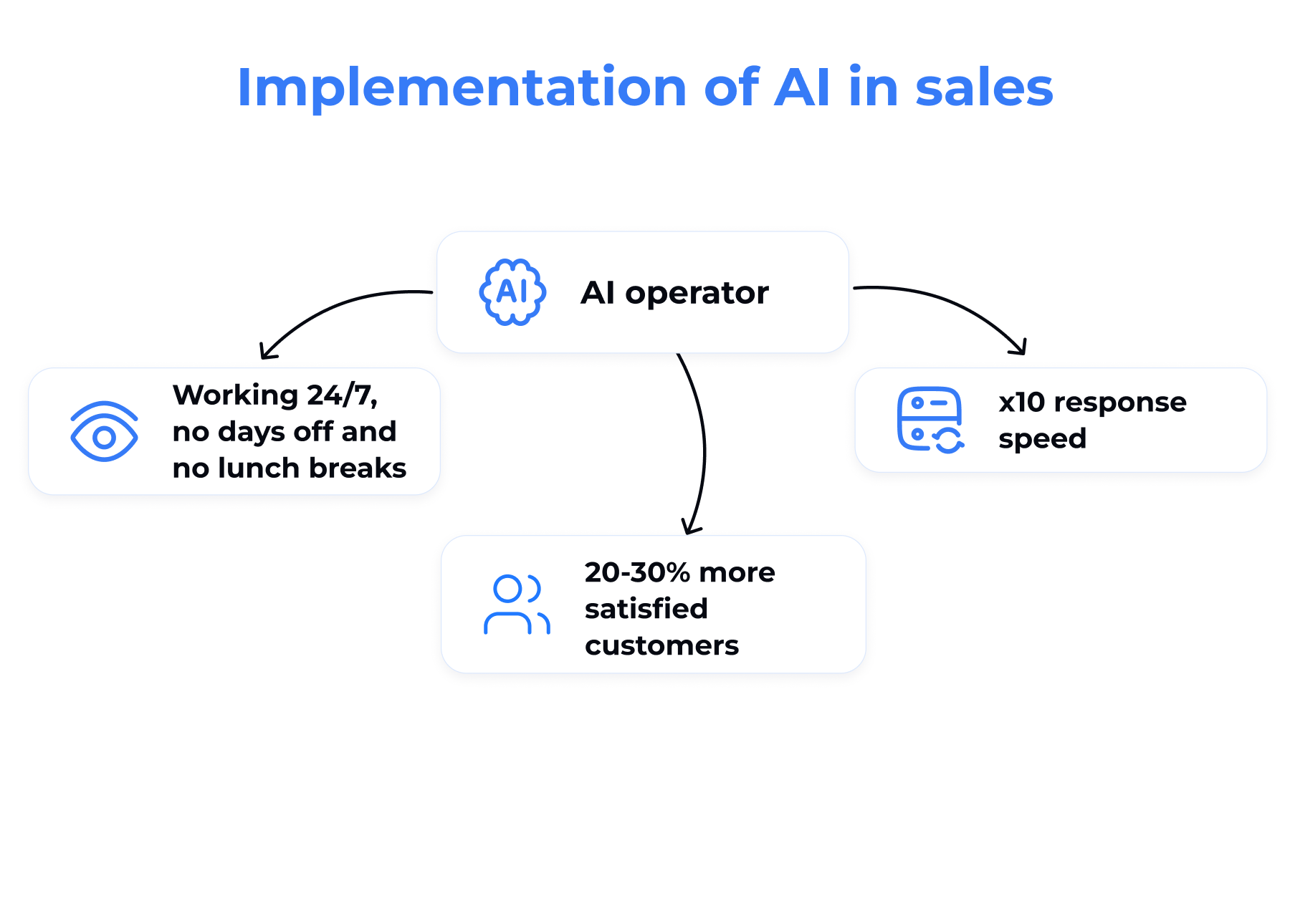
How does the picture change after the introduction of an AI manager in the sales department?

Profits of AI Operator in B2B sales

After introducing an AI operator, pricing becomes consistent: calculations follow the same logic every time, eliminating the human factor and reducing the risk of formula errors.

As a result, employees can focus on complex negotiations and non-standard deals instead of routine calculations.

Three signs when it's time to automate B2B sales

Not every business is ready for implementation right now. But there are three signals that the moment has come:

  • support is overloaded;
  • applications are received outside of business hours;
  • The flow is growing, but it is impractical to expand the staff.

In B2B, there’s another important factor: clients expect to be recognized. An AI operator takes into account request history and conversation context, allowing it to deliver personalized responses rather than generic ones.

A special case in B2B automation: consulting sales

There is a type of B2B sale where fully automating the dialogue is a detrimental idea: consultative deals. These usually involve long sales cycles, multiple stakeholders on the client side, and strategic decisions that affect budgets and business processes.

In these cases, the client isn’t just buying a product—they’re buying an understanding of their situation. Personal interaction is essential. To prepare properly, a manager needs to review the history of communication, understand the client’s business structure, gather background information, and compare the client’s requirements with the capabilities of the solution.

When the amount of information is large, preparing for a single meeting can take hours. Here, AI supports the process differently. It can:

  • structure the client’s materials
  • highlight key requirements
  • compile a brief summary of the deal
  • prepare a list of clarifying questions

In this context, an AI meeting assistant becomes especially useful. It records calls, generates summaries, captures agreements, and assigns follow-up tasks. When teams handle many calls and would otherwise need to document everything manually, this kind of tool saves hours of work and reduces the risk of missed decisions.


How to implement artificial intelligence in B2B sales?

1

Audit and Planning

We identify the key tasks—processing incoming requests, supporting customers, or automating internal workflows. Then we analyze the client’s current infrastructure to determine how AI can be seamlessly integrated into their operations.

2

Knowledge Base Preparation

The knowledge base forms the system’s foundation. We upload service descriptions, pricing formulas, regulations, document templates, and contact information. The more complete and accurate the data, the more precise the AI’s responses will be.
3

Logic and Integration Setup

We design interaction scenarios and connect the AI to CRM systems, messaging platforms, and email. Routing is configured to define which tasks the AI handles autonomously and which are escalated to human managers.
4

Testing

The system is tested for both standard and edge-case scenarios. We evaluate response accuracy, logic stability, and communication quality. Skipping this stage can result in early errors and inefficiencies.
5

Launch and Maintenance

Implementation doesn’t stop at launch. The knowledge base is continuously updated, and interaction scenarios are refined based on real dialogues. Over time, the system becomes increasingly accurate and efficient.

The Benefits of an AI Operator for Business

When AI handles routine tasks, the entire B2B sales funnel benefits. According to Juniper Research, by 2027 AI agents will process over 34 billion requests per year—ten times more than the 3.3 billion in 2025. Automating routine work is quickly becoming a strategic advantage.

For Managers and Product Owners

The strategic focus is on seeing the big picture. An AI operator maintains a complete record of all requests, helping identify bottlenecks and problem areas. Beyond a simple log of dialogues, it provides analytics on customer satisfaction, highlights weak scenarios, and points to specific opportunities for growth.
 

For Project and Operations Managers

Operational efficiency is about order and speed. With a digital employee in place, support teams experience a significant reduction in workload. All requests are routed to a centralized system where routine processes are automated. At the same time, corporate communication standards are maintained consistently—the AI never tires and never lapses into informal or inappropriate tones.

Our Projects

Frequent questions

How difficult is it to integrate an AI operator into existing processes?
Can an AI operator completely replace managers?
In which B2B areas does automation with AI have the maximum effect?

Discuss the project with the LighTech team

Book an appointment

Share

Tell us about your project
Name
Contact
Message
Attach file +
Request to get files
Name
Send files
Message
Thanks!
Your request has been sent
After processing, our manager will contact you