
In Russia and the CIS countries, the 1C platform is popular in the field of business process automation. Effective use of this system requires technical expertise and a professional approach to its implementation and support.
Companies without their own IT department usually choose to collaborate with external specialists through outsourcing and outstaffing 1C developers. Businesses with a well-developed IT infrastructure face a difficult dilemma.: choose 1C programmers or attract external specialists.
The division of opinions inspired us to study the issue of preferences more and to conduct analytical work on both models of cooperation. Our article will help you make a choice between hiring a full-time employee and outsourcing and austaffing 1C specialists.
Before getting to the heart of the topic, it's worth understanding the concepts of outstaffing and personnel outsourcing — what it is in simple terms. These cooperation models are often mentioned together, but they are fundamentally different approaches to organizing work with external specialists.
Outstaff is when the customer is offered cooperation with a qualified specialist, which he can manage independently. The company obtains professional competencies and determines how they can be applied to achieve its goals. This works on the principle of "renting" employees.
Outsourcing is when a customer sets a task, and a team of external specialists implements it under their own management. With this model, the company enters into a contract to perform specific tasks, getting a ready result. The customer is exempt from the need to organize workplaces and pay taxes, limited only to the payment of services under the contract. The contractor assumes full responsibility for the performance of the work and reporting.
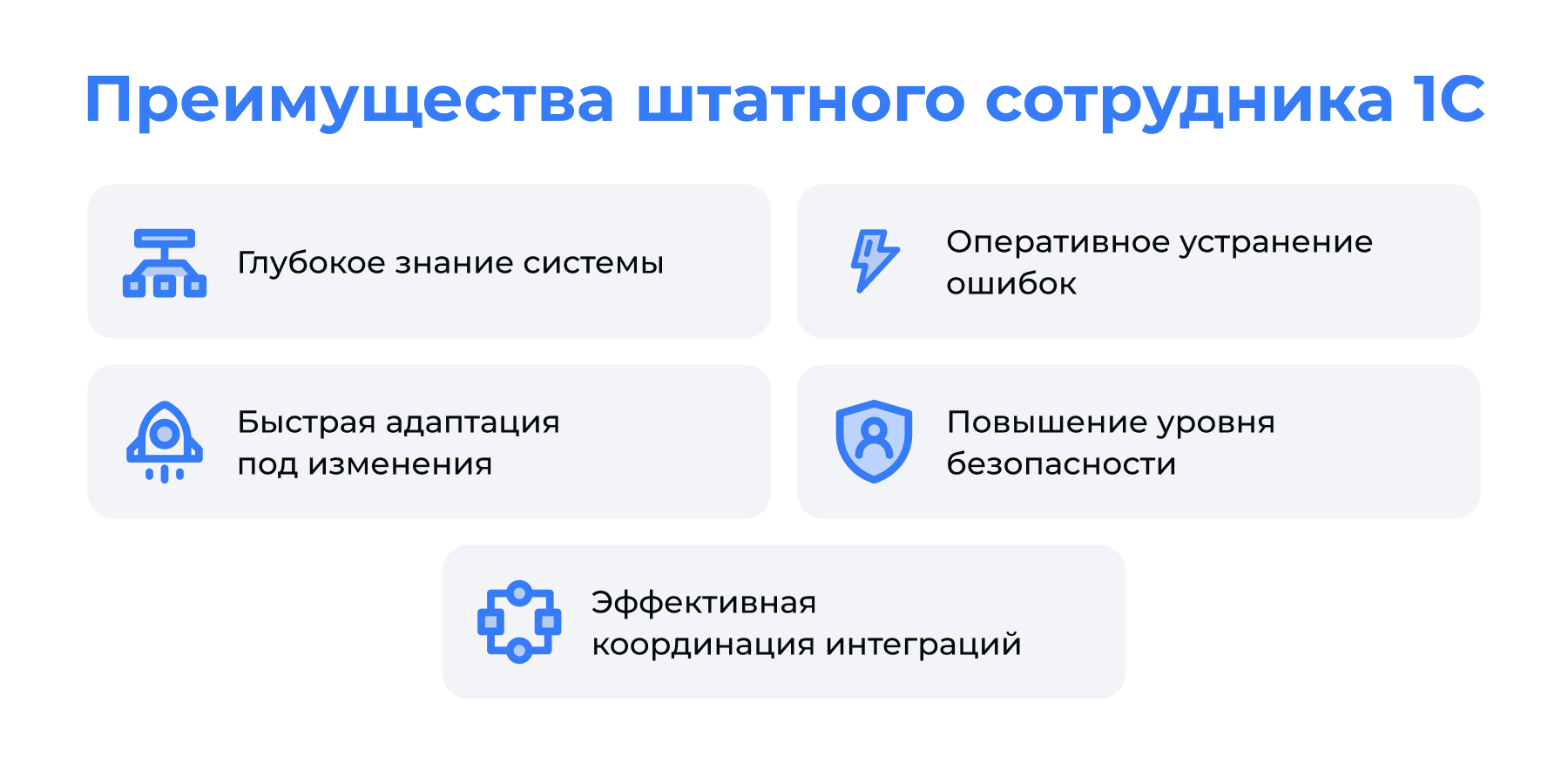
A company should consider hiring a full-time 1C programmer when it uses a complex, multi-level 1C configuration that requires constant attention and maintenance. The presence of an employee when working with business processes is necessary because of the regular adjustment and adaptation to the changing needs of the organization.
A full-time employee is also necessary if the company is developing a comprehensive IT ecosystem, where the 1C system is integrated with other software solutions and requires constant coordination and configuration of interaction between various components.
There are situations when an organization works with confidential data or state secrets. In these cases, having its own trusted specialist becomes a prerequisite for safe operation.
Many consider the main advantage of a full-time specialist to be his immersion in the specifics of the company. This argument only works if there is a strong team of 1C professionals, but the labor market creates obstacles to the formation of such a team.:
There is also an opinion about the financial benefits of maintaining a full-time programmer. In practice, the situation looks different.:
The advantage of direct control over a full-time employee also requires rethinking. IT companies offer a reliable guarantee system:
The traditional arguments in favor of full-time specialists require rethinking in the new market conditions.
We adhere to a clear structure of communication with clients. Our development workflow is completely transparent to you.
Weekly reviews:
At the end of each key stage of the project, we make a presentation:
At the end of each month, we provide:
You will always be aware of the project status and will be able to monitor the work process.
Companies usually turn to outstaffing and outsourcing services when the internal resources of the IT department are insufficient to implement complex technical tasks or large-scale changes in the information system.
The development, implementation and maintenance of 1C-based solutions in the outsourcing and outstaff format helps:
External 1C specialists ensure a smooth transition with minimal risks to business processes.
Outsourcing and outstaffing of 1C programmers provides companies with flexible resource management capabilities and allows them to quickly scale a team and attract highly specialized experts while optimizing personnel costs. Proper organization of work processes and the choice of a partner will reduce potential risks.
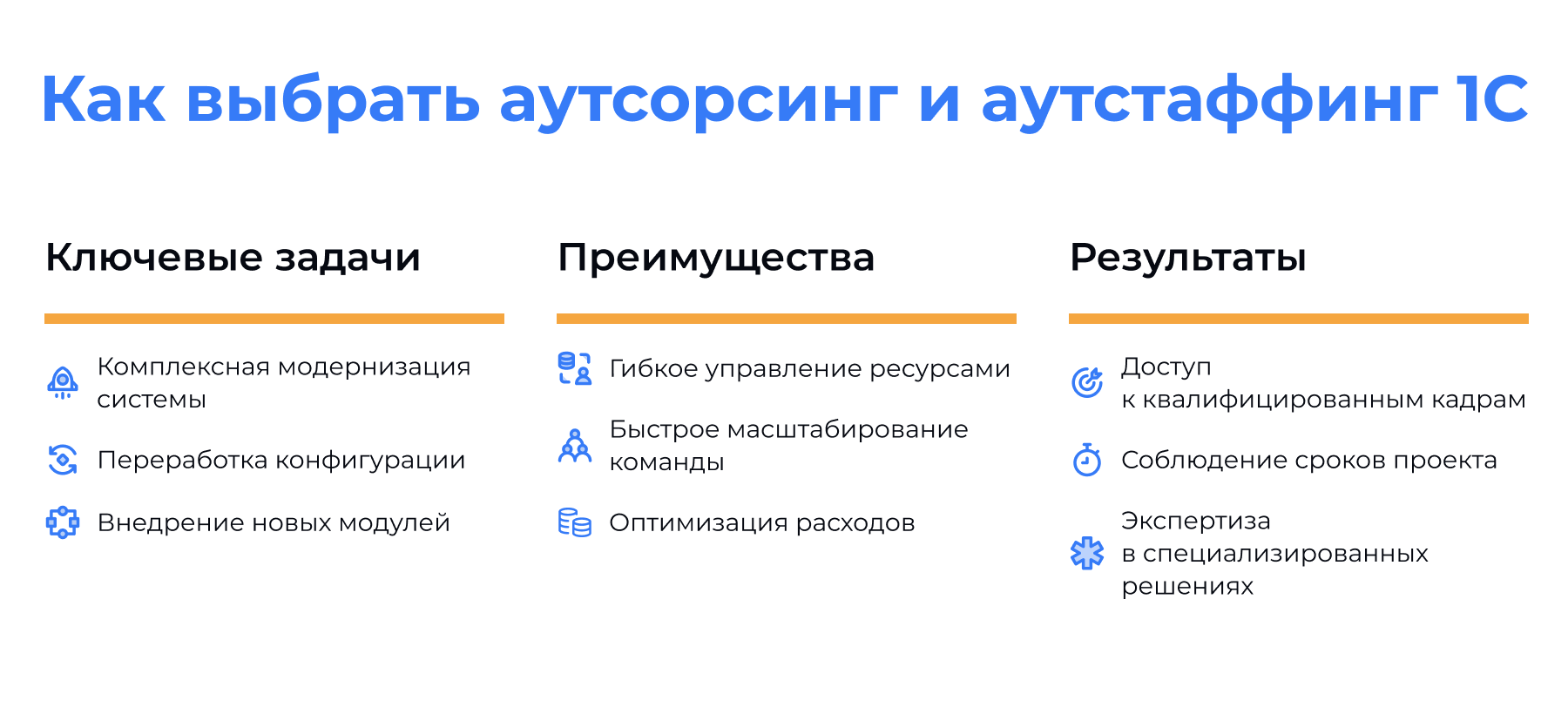
The attracted developers for companies help in eliminating the shortage of qualified personnel, unloading employees from current tasks, temporarily increasing the team for project implementation, meeting deadlines with limited resources and implementing specialized solutions with the involvement of highly qualified experts.
Practice shows that for many organizations, a hybrid approach combining full-time employees and engaged specialists becomes the most effective. This model allows you to optimally distribute tasks and ensure a balance between the stability and flexibility of IT outstaffing and outsourcing.
Below we have compiled a comparative table with the distinctive characteristics of using external and full-time 1C developers.
| Criteria | Full-time developers | Outsourcing and outstaffing | |
| Access to competencies | Limited by the skills of the current team |
Access to diverse experts |
|
| Expenses | High staff costs (salary, taxes, social package) |
Savings due to the absence of fixed costs for full-time employees |
|
| Continuity of service | Dependence on vacations, sick days, and staff turnover |
Guaranteed continuity |
|
| Flexibility | Less flexible when scaling | Rapid resource mobilization | |
| Efficiency in complex projects | Depends on the experience of the team | High competence in complex implementations | |
| Understanding the specifics of the company | Deep knowledge of internal processes | It takes time to study the company's features | |
| Responding to urgent tasks | The ability to respond quickly | The response depends on the availability of resources | |
| Engagement | Continuous participation in operational tasks | Work on request |
Full-time specialists do a good job with the operational and internal tasks of the company. External specialists are effective for complex and large-scale projects, temporary tasks and budget savings.
Hiring full-time 1C developers has its advantages, but it may not always be advisable. The selection of a hiring format for the IT department responsible for managing the 1C system should take into account the specific needs and goals of the company.
An example of how external 1C developers from the LighTech case work, where the 1C system was integrated with a document automation engine. Customized solutions have been developed. This made it possible to speed up the process, minimize errors in tax accounting and significantly save the budget on hiring full-time employees.
In many cases, a mixed approach combining full-time employees and outsourced specialists is the best solution, but it is important to ensure effective interaction between all team members.